
AI Content Generation and Marketing Automation: The Complete Guide to Scaling Creative Output in 2026
AI is transforming content creation from a bottleneck into a scalable engine. From blog posts and social media to video and personalized campaigns, discover how AI-powered content automation is reshaping digital marketing.

Codmaker
Independent product lab
The Content Scaling Crisis and How AI Is Solving It
Every digital business faces the same challenge: the demand for content is growing exponentially while the capacity to produce it remains stubbornly finite. Modern marketing requires a constant stream of blog posts, social media updates, email campaigns, product descriptions, video scripts, podcast outlines, infographics, and personalized communications—each tailored for different audiences, platforms, and stages of the customer journey. For most organizations, content production is the single largest bottleneck in their marketing operation. AI-powered content generation is not just an efficiency tool; it is the solution to a fundamental scaling crisis that threatens growth.
The AI content generation market has matured dramatically since the early days of GPT-3 powered text spinners. The 2026 generation of AI content tools produces output that is virtually indistinguishable from expert human writing when properly guided. These tools can match brand voice and tone, follow editorial guidelines, incorporate SEO best practices, and maintain factual accuracy through integration with verified data sources. The technology has moved from 'good enough for rough drafts' to 'production-ready for most content types,' fundamentally changing the economics of content marketing.
The shift is not about replacing human writers—it is about changing what human writers spend their time on. In a traditional content workflow, a writer might spend 70% of their time on research, outlining, and first-draft creation, and 30% on refinement, fact-checking, and polishing. AI inverts this ratio. The AI handles the research-intensive, structure-heavy work of creating comprehensive first drafts, while human writers focus on adding perspective, verifying claims, injecting brand personality, and ensuring the final product meets quality standards. This human-AI collaboration model produces more content, faster, at higher quality than either humans or AI could achieve alone.
The business impact is measurable and substantial. Companies that have adopted AI-powered content workflows report producing 3-5x more content per writer, reducing average content production time by 60%, and maintaining or improving quality scores as measured by engagement metrics and SEO performance. For content-driven businesses—media companies, SaaS marketers, e-commerce brands—this productivity multiplication changes the competitive landscape entirely. The organizations that master AI-augmented content production will outproduce, outrank, and outperform those that continue relying on purely manual workflows.
Multi-Modal Content Generation: Text, Image, Video, and Beyond
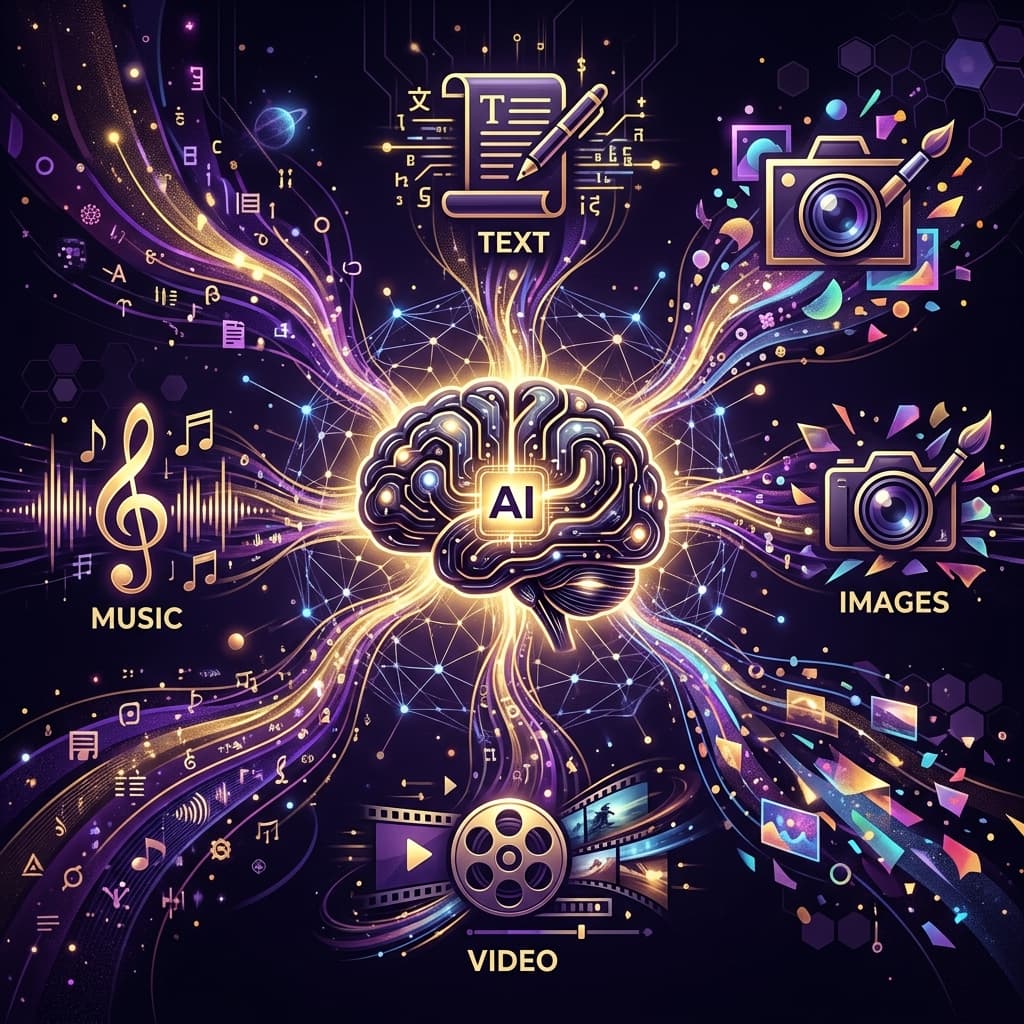
The most significant advancement in AI content generation in 2026 is the convergence of multi-modal capabilities. Individual AI tools for text, images, video, and audio have existed for years, but the current generation integrates these capabilities into unified platforms that can produce complete, multi-format content packages from a single brief. Describe a blog post topic and the AI generates the article text, creates matching header images, produces social media variants with platform-specific formatting, and even generates a video summary—all maintaining consistent messaging and visual style.
AI image generation has reached a level of quality and controllability that makes it practical for professional marketing use. Tools like Midjourney, DALL-E 3, and Stable Diffusion can produce product photography, lifestyle imagery, infographics, and social media graphics that are indistinguishable from professionally shot and designed content. The key advancement is controllability—brand guidelines can be encoded as style references, ensuring that every generated image matches the organization's visual identity. This eliminates the expensive and time-consuming process of custom photography and graphic design for routine marketing assets.
AI video generation is the fastest-growing segment of content automation. Platforms like Runway, Pika, and HeyGen can generate short-form video content from text descriptions, create talking head videos from scripts using AI avatars, add professional motion graphics and transitions, and produce personalized video messages at scale. While AI-generated video is not yet a replacement for high-production-value brand campaigns, it is more than adequate for explainer videos, social media content, product demos, internal communications, and personalized sales outreach—categories that represent the majority of business video content needs.
Audio content generation rounds out the multi-modal suite. AI voice synthesis can produce podcast episodes, audiobook narration, voiceover for video content, and interactive voice responses with natural-sounding speech in dozens of languages and accents. Text-to-speech technology has advanced to the point where AI voices are often preferred by audiences over amateur human narration because of their consistency, clarity, and professional quality. For organizations producing content for global audiences, AI voice synthesis eliminates the cost and complexity of hiring voice talent for every language and market.
- Multi-modal platforms produce text, images, video, and audio from a single creative brief
- AI image generation matches professional photography quality with brand-consistent style control
- AI video: explainers, demos, social content, and personalized sales outreach at scale
- Voice synthesis produces natural narration in dozens of languages—often preferred over amateur human recordings
- Style references encode brand guidelines to ensure visual and tonal consistency across all AI-generated content
- End-to-end content packages reduce production time from weeks to hours for routine marketing assets
Personalization at Scale: The Holy Grail of Marketing Automation
Personalization has long been recognized as the most effective marketing strategy—personalized content outperforms generic content by 3-5x on every engagement metric. The challenge has always been scale: creating personalized versions of content for every segment, every channel, and every stage of the customer journey requires a volume of content production that is economically prohibitive with manual workflows. AI-powered content personalization finally makes true one-to-one marketing achievable at enterprise scale.
Dynamic content generation creates personalized versions of emails, landing pages, product descriptions, and advertisements in real-time based on individual user data. When a visitor lands on a website, the AI considers their browsing history, demographic data, purchase behavior, and current context to generate a personalized version of the page—adjusting headlines, imagery, product recommendations, testimonials, and calls-to-action to resonate with that specific individual. A/B testing happens continuously, with the AI learning which personalization strategies perform best for each user segment.
Email marketing has been particularly transformed by AI-powered personalization. Instead of writing a few email templates and segmenting the audience into broad groups, marketers now define the campaign objectives and customer data signals, and the AI generates individually personalized emails for each recipient. Subject lines, body copy, product recommendations, imagery, and send timing are all optimized per recipient based on their engagement history and predicted preferences. Companies implementing AI-personalized email report 40-80% improvements in open rates and 2-3x improvements in conversion rates compared to traditional segmented campaigns.
The ethical dimensions of AI-powered personalization deserve serious attention. There is a fine line between helpful personalization and invasive surveillance. Consumers increasingly value transparency about how their data is used and control over what is personalized. Organizations that push personalization too far—creating messages that feel uncomfortably 'knowing' or using data that consumers did not expect to be leveraged—risk backlash that damages brand trust. The most successful personalization strategies are those that feel helpful and relevant without being intrusive, respecting the implicit social contract between brands and consumers about how personal data should be used.
- Personalized content outperforms generic content by 3-5x on engagement metrics across all channels
- Dynamic content generation creates individualized pages, emails, and ads in real-time from user data
- AI-personalized email achieves 40-80% open rate improvements and 2-3x conversion rate gains
- Continuous A/B testing: AI learns which personalization strategies work best per user segment
- Ethical balance: personalization must feel helpful, not invasive—transparency and user control are essential
- One-to-one marketing at enterprise scale is now economically feasible through AI content generation
Related reading

Apr 5, 2026
AI-Powered Workflow Automation in 2026: The Trends Reshaping How Businesses Operate
From intelligent document processing to autonomous decision engines, AI-driven workflow automation is eliminating manual tasks at an unprecedented pace. Here is what every business leader and developer needs to know about the trends defining 2026.
Apr 2, 2026
No-Code AI Platforms in 2026: How Non-Developers Are Building Intelligent Applications
The barrier between idea and AI-powered application has never been lower. No-code AI platforms are enabling business analysts, marketers, and entrepreneurs to build sophisticated intelligent applications without writing a single line of code.

Mar 30, 2026
AI in Cybersecurity: How Automated Threat Detection and Response Is Transforming Digital Defense in 2026
Cyberattacks are faster, smarter, and more frequent than ever. AI-powered cybersecurity systems are the only defense capable of matching the speed and sophistication of modern threats. Here is how AI is reshaping digital security.