
AI-Powered Workflow Automation in 2026: The Trends Reshaping How Businesses Operate
From intelligent document processing to autonomous decision engines, AI-driven workflow automation is eliminating manual tasks at an unprecedented pace. Here is what every business leader and developer needs to know about the trends defining 2026.

Codmaker
Independent product lab
The Automation Revolution: Why 2026 Is the Tipping Point
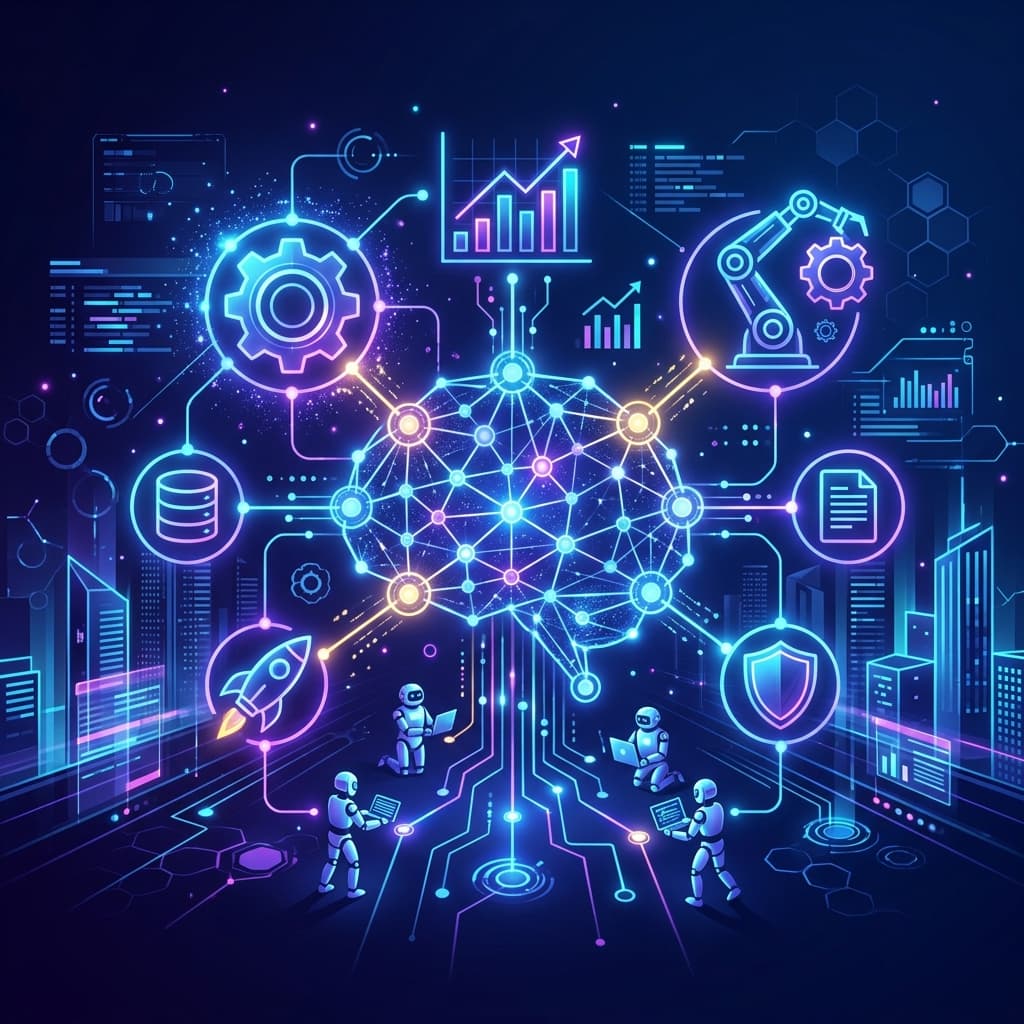
The convergence of large language models, computer vision, and robotic process automation has created a perfect storm in 2026. For the first time, AI systems can not only understand unstructured data—emails, invoices, contracts, support tickets—but also take autonomous action on that data without human intervention. This is not incremental improvement; it is a fundamental shift in how businesses operate, and organizations that fail to adapt risk being left behind by competitors who automate faster and smarter.
According to McKinsey's latest research, AI-powered automation could add up to $4.4 trillion in value to the global economy annually. The industries seeing the fastest adoption are financial services, healthcare, manufacturing, and logistics—sectors where repetitive, rule-based processes consume enormous amounts of human time. But the trend extends far beyond these traditional strongholds. Marketing teams are automating campaign optimization. HR departments are automating candidate screening and onboarding. Legal teams are automating contract review and compliance monitoring. The common denominator is that any process involving structured decision-making on semi-structured data is now a candidate for intelligent automation.
What distinguishes the 2026 wave of automation from previous generations is adaptability. Earlier automation tools—like traditional RPA (Robotic Process Automation)—could only follow rigid scripts. If an invoice format changed slightly, the bot would break. AI-powered automation adapts dynamically. It understands intent, not just format. It can process an invoice whether it arrives as a PDF attachment, an email body, a scanned image, or even a photograph taken on a phone. This flexibility eliminates the brittleness that made earlier automation initiatives expensive to maintain and limited in scope.
The human impact is equally significant. Rather than eliminating jobs, the current automation wave is transforming them. Knowledge workers who once spent 60-70% of their time on data entry, status updates, report generation, and routine communications are being freed to focus on strategic thinking, relationship building, and creative problem-solving. Organizations that frame automation as 'augmentation' rather than 'replacement' are seeing higher employee satisfaction, lower turnover, and faster adoption of new tools.
Intelligent Document Processing: The Gateway to Enterprise Automation
Intelligent Document Processing (IDP) has emerged as the single most impactful entry point for enterprise AI automation. Every organization processes thousands of documents daily—invoices, purchase orders, contracts, applications, compliance forms—and the majority still require manual data extraction and entry. IDP platforms powered by foundation models can now extract, classify, validate, and route document data with accuracy rates exceeding 95%, often surpassing human accuracy while operating at 100x the speed.
The latest generation of IDP solutions goes beyond simple OCR (Optical Character Recognition). They understand the semantic meaning of document content. An AI system processing a lease agreement does not just extract the rent amount and tenant name—it understands the relationship between clauses, identifies obligations and contingencies, flags unusual terms, and can compare the agreement against standard templates to highlight deviations. This level of comprehension transforms document processing from a data entry task into an intelligent analysis function.
Integration with downstream systems is where IDP delivers its full value. Modern IDP platforms connect directly to ERP systems (SAP, Oracle), CRM platforms (Salesforce, HubSpot), accounting software (QuickBooks, Xero), and workflow engines (ServiceNow, Jira). When an invoice is processed, the extracted data flows automatically into the accounting system, triggers approval workflows, updates inventory records, and generates payment schedules—all without a human touching a keyboard. Companies implementing end-to-end IDP report invoice processing time reductions from days to minutes and cost savings of 60-80% per document.
The technology has also become dramatically more accessible. Where enterprise IDP platforms once cost hundreds of thousands of dollars and required months of implementation, modern cloud-based solutions offer pay-per-document pricing with pre-trained models that work out of the box for common document types. This democratization means that small and medium businesses—not just enterprise giants—can benefit from intelligent document automation.
- IDP achieves 95%+ accuracy on unstructured documents—often exceeding human operators
- Semantic understanding goes beyond OCR: clauses, obligations, and deviations are identified automatically
- End-to-end integration: documents flow from inbox to ERP, CRM, and accounting systems without manual steps
- Processing time reduced from days to minutes with 60-80% cost savings per document
- Cloud-based platforms with pay-per-document pricing make IDP accessible to SMBs
- Pre-trained models work out of the box for invoices, contracts, receipts, and applications
Autonomous Decision Engines: AI That Acts, Not Just Recommends
The most transformative trend in AI automation is the shift from recommendation engines to autonomous decision engines. Previous-generation AI systems would analyze data and present options to a human decision-maker. The current generation can be authorized to make and execute decisions within defined boundaries—approving routine purchase orders, routing support tickets, adjusting pricing, scheduling resources, and managing inventory replenishment without requiring human approval for every action.
The architecture enabling autonomous decisions combines several AI capabilities. Natural language understanding interprets incoming requests and documents. Machine learning models assess risk, predict outcomes, and score alternatives. Rules engines enforce business policies and compliance requirements. And orchestration layers execute the chosen action across integrated systems. The result is an AI system that can handle the full lifecycle of a decision: receive input, analyze context, evaluate options, select the best action, execute it, and monitor the outcome.
Trust and governance are the critical enablers—or blockers—of autonomous decision adoption. Organizations that deploy autonomous AI without proper guardrails risk errors that cascade through their systems. The best implementations establish clear decision boundaries: the AI handles routine decisions (90% of volume) autonomously while escalating edge cases and high-value decisions to human review. Audit trails log every autonomous decision for compliance review, and feedback loops continuously improve accuracy based on outcomes.
The business impact is substantial. Financial institutions using autonomous decision engines for loan underwriting report 40% faster processing with equivalent or better risk assessment. E-commerce companies using AI-driven pricing automation see 15-25% revenue improvements. Customer service operations using autonomous ticket routing and resolution report 50-70% reductions in response time. The organizations achieving these results share a common approach: they start with narrow, well-defined decision domains, prove the AI's reliability, and gradually expand scope as trust is established.
Hyperautomation: Connecting the Dots Across the Enterprise
Hyperautomation—the concept of automating everything that can be automated—has moved from Gartner buzzword to practical reality in 2026. The key insight driving hyperautomation is that individual automation solutions, no matter how powerful, deliver limited value when they operate in isolation. The real transformation happens when AI automation is connected across the entire value chain: from customer acquisition to service delivery to financial reconciliation.
Building a hyperautomation strategy starts with process mining—using AI to analyze event logs and discover how work actually flows through the organization (as opposed to how it is supposed to flow). Process mining tools like Celonis, UiPath Process Mining, and Microsoft Process Advisor reveal bottlenecks, redundancies, and deviation patterns that are invisible to manual analysis. These insights form the blueprint for targeted automation initiatives that deliver maximum impact.
The technology stack for hyperautomation is converging around platforms that combine AI, RPA, API integration, low-code development, and analytics in a unified environment. UiPath, Microsoft Power Automate, and Automation Anywhere have all evolved from simple RPA tools into comprehensive automation platforms. These platforms provide a visual canvas for building automation workflows, pre-built connectors for hundreds of enterprise applications, AI models for document processing and decision-making, and dashboards for monitoring automation performance.
For development teams, hyperautomation creates new architectural patterns. Event-driven architectures replace batch processing. API-first designs enable seamless integration between automated and manual processes. Observability platforms monitor automated workflows with the same rigor applied to production software. And AI governance frameworks ensure that automated decisions are explainable, auditable, and aligned with business policies. The engineers who understand these patterns will be the most valuable members of any digital transformation initiative.
- Process mining reveals how work actually flows—exposing bottlenecks invisible to manual analysis
- Hyperautomation connects individual automations into end-to-end value chains for maximum impact
- Unified platforms combine AI, RPA, API integration, and low-code in a single environment
- Event-driven architectures replace batch processing for real-time automation responsiveness
- AI governance frameworks ensure automated decisions are explainable and auditable
- Organizations report 30-50% operational cost reductions through comprehensive hyperautomation strategies
Related reading
Apr 2, 2026
No-Code AI Platforms in 2026: How Non-Developers Are Building Intelligent Applications
The barrier between idea and AI-powered application has never been lower. No-code AI platforms are enabling business analysts, marketers, and entrepreneurs to build sophisticated intelligent applications without writing a single line of code.

Mar 30, 2026
AI in Cybersecurity: How Automated Threat Detection and Response Is Transforming Digital Defense in 2026
Cyberattacks are faster, smarter, and more frequent than ever. AI-powered cybersecurity systems are the only defense capable of matching the speed and sophistication of modern threats. Here is how AI is reshaping digital security.
Mar 25, 2026
AI-Powered DevOps: How Intelligent Automation Is Revolutionizing CI/CD Pipelines and Infrastructure Management
From self-healing infrastructure to AI-driven deployment decisions, intelligent automation is transforming every aspect of DevOps. Discover how AI is making software delivery faster, more reliable, and more efficient than ever before.