
AI-Powered DevOps: How Intelligent Automation Is Revolutionizing CI/CD Pipelines and Infrastructure Management
From self-healing infrastructure to AI-driven deployment decisions, intelligent automation is transforming every aspect of DevOps. Discover how AI is making software delivery faster, more reliable, and more efficient than ever before.

Codmaker
Independent product lab
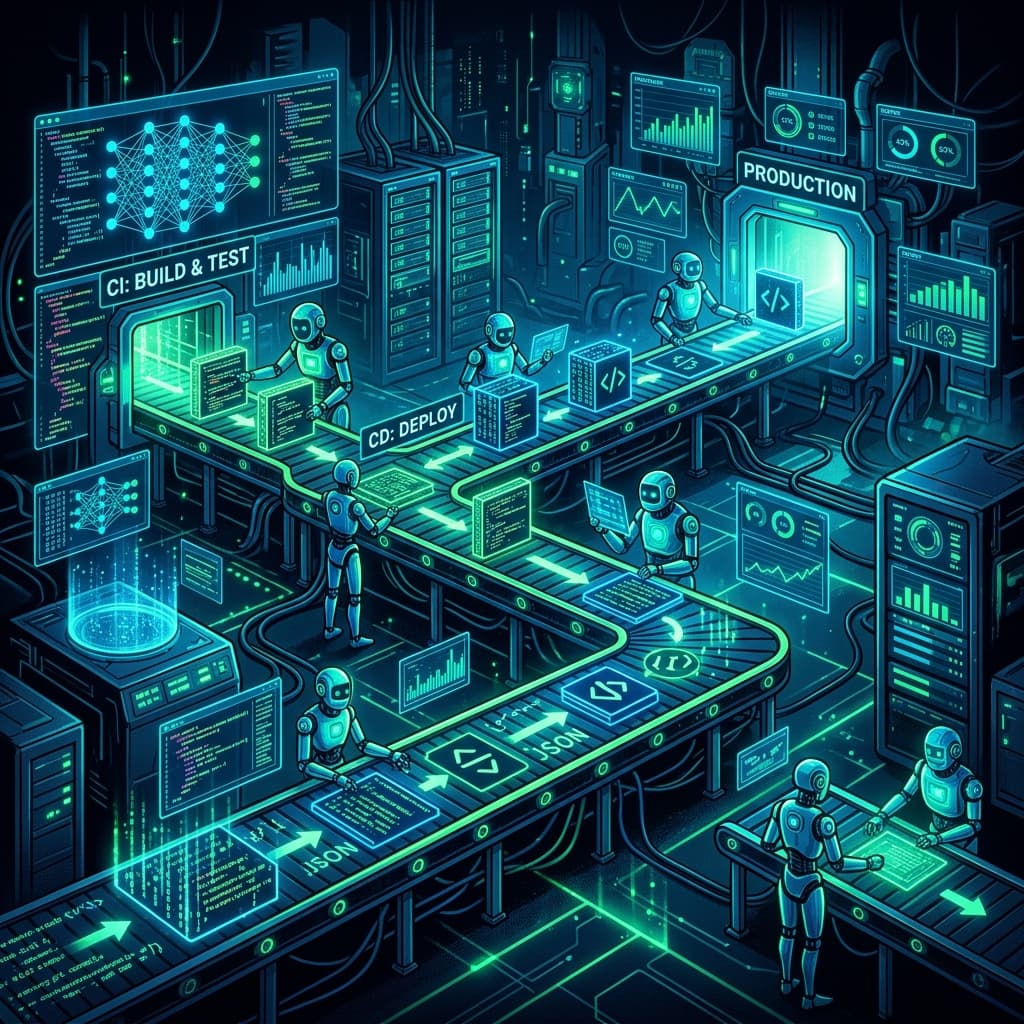
The Evolution from DevOps to AIOps: Why Intelligence Is the Missing Layer
DevOps revolutionized software delivery by breaking down silos between development and operations teams, introducing practices like continuous integration, continuous delivery, infrastructure as code, and observability. But as systems have grown in complexity—with microservices architectures, multi-cloud deployments, and thousands of daily releases—the volume of operational data and decisions has overwhelmed human capacity. AIOps (Artificial Intelligence for IT Operations) adds the intelligence layer that DevOps needs to scale, using machine learning to analyze operational data, detect patterns, predict issues, and automate responses that would be impossible for human operators to handle at current speeds and scales.
The scale of modern infrastructure operations makes AI essential, not optional. A mid-size technology company might operate hundreds of microservices across multiple cloud regions, generating terabytes of logs, metrics, and traces daily. Each deployment creates ripple effects across dependent services that are nearly impossible to predict manually. Alert volumes measured in thousands per day create fatigue that causes real incidents to be overlooked. AI-powered tools cut through this complexity by correlating signals across the entire stack, identifying root causes in minutes rather than hours, and predicting failures before they impact users.
The economic case for AIOps is compelling. Gartner estimates that organizations implementing AIOps achieve 30-50% reductions in mean time to resolution (MTTR) for production incidents, 25-40% reductions in unplanned downtime, and 20-35% improvements in operational efficiency. For organizations where downtime costs $100,000 or more per hour—common in e-commerce, financial services, and SaaS—these improvements translate directly into millions of dollars in saved revenue and reduced operational costs.
What distinguishes AIOps from traditional monitoring and alerting is proactivity. Traditional tools tell you when something has broken. AIOps tells you when something is about to break, giving you the opportunity to prevent the failure entirely. Predictive analytics can identify degradation patterns—gradual memory leaks, increasing response times, growing queue depths—days or weeks before they cause outages. This shift from reactive firefighting to proactive prevention is one of the most valuable transformations AI brings to operations teams.
AI-Driven CI/CD: Smarter Pipelines for Faster, Safer Releases
Continuous Integration and Continuous Delivery pipelines are the backbone of modern software development, but they are often sources of significant waste and risk. Build times measured in minutes or hours slow developer productivity. Flaky tests create false negatives that erode confidence in the test suite. Deployment failures caused by configuration drift create outages that impact users. AI-powered CI/CD addresses each of these pain points with intelligent automation that makes pipelines faster, more reliable, and more efficient.
Intelligent test selection is one of the highest-impact applications of AI in CI/CD. Traditional pipelines run the entire test suite for every code change, regardless of what was modified. AI-powered test selection analyzes the code change, maps it to affected test cases using dependency analysis and historical correlation, and runs only the tests that are relevant to the change. This approach reduces test execution time by 60-80% while maintaining equivalent defect detection rates. For large codebases where full test suites take 30-60 minutes, intelligent test selection can reduce pipeline times to under 10 minutes—a game-changer for developer productivity.
Deployment risk assessment uses machine learning to predict the likelihood of a deployment causing issues in production. The AI analyzes multiple signals: the volume and complexity of code changes, the areas of the codebase affected, the test coverage of changed code, historical deployment success rates for similar changes, and the current state of production systems. High-risk deployments are flagged for additional review, staged rollouts, or deployment to canary environments before full production release. This intelligent risk assessment catches dangerous deployments that would slip through manual review processes.
Self-healing pipelines represent the frontier of AI-powered CI/CD. When a build fails, the AI analyzes the failure, identifies the root cause, and in many cases automatically fixes the issue. Flaky tests are automatically retried with backoff strategies. Infrastructure provisioning failures trigger automatic retry on alternative resources. Dependency resolution conflicts are resolved by the AI selecting compatible versions. These self-healing capabilities eliminate the most common sources of pipeline friction—the mundane failures that interrupt developer flow and consume engineering time on problems that have straightforward solutions.
- Intelligent test selection reduces pipeline execution time by 60-80% without sacrificing quality
- AI deployment risk assessment predicts production issues before code is released
- Self-healing pipelines automatically fix flaky tests, infrastructure failures, and dependency conflicts
- ML models analyze historical data to optimize build caching and parallelization strategies
- Canary analysis uses AI to detect anomalies in staged deployments before full rollout
- Pipeline analytics identify bottlenecks and recommend optimizations for faster developer feedback loops
Self-Healing Infrastructure: AI-Powered Reliability at Scale
Self-healing infrastructure is the ultimate expression of AI-powered DevOps automation. These systems continuously monitor the health of every component in the stack—servers, containers, databases, load balancers, network devices—and automatically remediate issues without human intervention. When a container crashes, the orchestrator restarts it. When a server becomes unreachable, traffic is automatically rerouted. When database replication lag exceeds thresholds, the system scales read replicas. When API response times degrade, the auto-scaler provisions additional instances.
The sophistication of self-healing has advanced far beyond simple restart policies. AI-powered systems perform root cause analysis before taking action, ensuring that the remediation addresses the actual problem rather than treating symptoms. If containers are crashing due to a memory leak in the application code, simply restarting them creates a cycle of crash-restart that degrades performance. An intelligent self-healing system recognizes the pattern, identifies the memory leak as the root cause, alerts the development team, and implements temporary mitigations (like scheduled restarts before memory exhaustion) while the fix is developed.
Chaos engineering—the practice of deliberately injecting failures into production systems to test resilience—has been transformed by AI. Traditional chaos engineering requires teams to manually design experiments, inject faults, and analyze results. AI-powered chaos platforms automatically identify the most impactful failure scenarios based on system architecture and dependency analysis, inject faults in controlled ways, monitor system behavior, and generate detailed reports on resilience gaps. This automated approach makes chaos engineering practical for organizations that lack dedicated reliability engineering teams.
The operational model for self-healing infrastructure represents a fundamental shift in how operations teams work. Instead of responding to incidents—waking up at 3 AM to restart a service—engineers focus on building the self-healing capabilities that prevent incidents from requiring human intervention. The on-call rotation becomes less about fixing problems and more about reviewing the AI's automated responses, improving remediation playbooks, and addressing the root causes that create recurring issues. This shift from operational firefighting to reliability engineering is better for both system reliability and engineer well-being.
Implementing AI-Powered DevOps: A Practical Roadmap
Adopting AI-powered DevOps is a journey that starts with strong observability foundations. AI systems need high-quality data to learn from. Before implementing any AI-powered tools, ensure comprehensive logging, metrics collection, and distributed tracing across your stack. Standardize on formats like OpenTelemetry for portability, and invest in a data platform that can store, query, and analyze operational data at scale. Without this foundation, AI tools will produce unreliable results that erode trust rather than build it.
Start with the highest-impact, lowest-risk applications. Alert correlation and noise reduction is an excellent entry point—it directly reduces operational burden without making autonomous decisions. Intelligent test selection is another high-impact, low-risk starting point for CI/CD improvement. These applications deliver visible value quickly, building organizational confidence in AI-powered tooling and creating the political capital needed for broader adoption.
Build the skills and culture needed for AI-augmented operations. DevOps engineers need basic understanding of machine learning concepts to effectively configure, monitor, and troubleshoot AI-powered tools. Create learning paths that cover anomaly detection principles, time-series analysis, and the specific AI capabilities of your tooling. Foster a culture of experimentation where teams are encouraged to try AI-powered approaches for operational challenges, share results, and iterate on what works.
Measure and communicate the impact of AI-powered DevOps investments. Track metrics that matter to the business: MTTR, deployment frequency, change failure rate, and unplanned downtime. Quantify the time savings from automated alert triage, faster incident resolution, and reduced pipeline wait times. Present these results in business terms—revenue protected, engineering hours saved, customer experience improved—to maintain executive support for continued investment in AI-powered operational capabilities.
- Start with observability: comprehensive logging, metrics, and tracing are prerequisites for AI-powered tools
- Begin with low-risk, high-impact applications: alert correlation and intelligent test selection
- Build ML literacy in DevOps teams: anomaly detection, time-series analysis, tool-specific AI capabilities
- Measure impact in business terms: revenue protected, engineering hours saved, customer experience improved
- Foster experimentation culture: encourage teams to try AI approaches and share results
- Standardize on OpenTelemetry for data portability across AI-powered observability platforms
Related reading
Apr 5, 2026
AI-Powered Workflow Automation in 2026: The Trends Reshaping How Businesses Operate
From intelligent document processing to autonomous decision engines, AI-driven workflow automation is eliminating manual tasks at an unprecedented pace. Here is what every business leader and developer needs to know about the trends defining 2026.
Apr 2, 2026
No-Code AI Platforms in 2026: How Non-Developers Are Building Intelligent Applications
The barrier between idea and AI-powered application has never been lower. No-code AI platforms are enabling business analysts, marketers, and entrepreneurs to build sophisticated intelligent applications without writing a single line of code.

Mar 30, 2026
AI in Cybersecurity: How Automated Threat Detection and Response Is Transforming Digital Defense in 2026
Cyberattacks are faster, smarter, and more frequent than ever. AI-powered cybersecurity systems are the only defense capable of matching the speed and sophistication of modern threats. Here is how AI is reshaping digital security.