
How AI Is Transforming Education: Personalized Learning, Virtual Tutors, and the Classroom of 2030
From adaptive learning platforms to AI tutors that never lose patience, artificial intelligence is reshaping how we teach and learn. Here is what the education revolution actually looks like in practice.

Codmaker
Independent product lab
The Promise of Truly Personalized Education
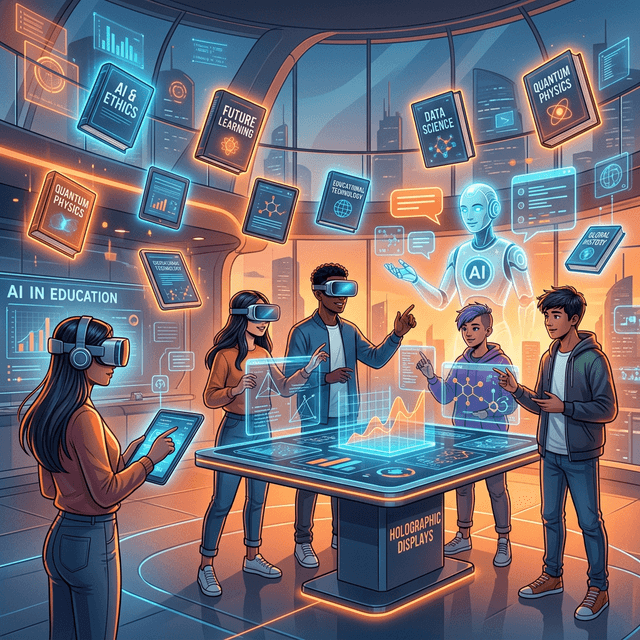
For centuries, education has operated on a fundamentally one-size-fits-all model. A teacher stands before a class of 20-30 students and delivers the same content at the same pace to everyone. This model persists not because educators believe it is optimal—every teacher knows that students learn at different rates, in different ways, and with different prior knowledge—but because the alternative, truly individualized instruction, would require a dedicated tutor for every student. This has been economically impossible. Until now.
AI-powered adaptive learning platforms are making personalized education scalable for the first time in history. These systems continuously assess each student's knowledge, identify gaps, adjust difficulty levels, and present material in the sequence and format most likely to promote learning for that specific individual. A student who grasps mathematical concepts quickly moves ahead while automatically receiving enrichment challenges. A student who struggles receives additional explanations, alternative representations, and targeted practice—all without the stigma of being visibly 'behind' their peers.
The evidence is compelling. Studies of AI-powered adaptive learning systems show learning gains equivalent to moving from the 50th percentile to the 68th percentile on standardized measures—roughly the same effect as reducing class size from 30 to 15 students, but at a fraction of the cost. In developing countries where teacher shortages are acute, AI tutoring systems are providing millions of students with access to quality instruction that would otherwise be completely unavailable.
However, the promise of AI in education comes with important caveats. Technology alone does not improve learning—it must be implemented thoughtfully within a broader educational context. The most effective approaches combine AI-powered personalization with human teachers who provide motivation, mentorship, social learning opportunities, and the kind of inspirational education that no algorithm can replicate. AI is a powerful tool, but it is most effective when wielded by skilled educators who understand its capabilities and limitations.
AI Tutors: Always Available, Infinitely Patient
AI tutoring systems represent one of the most immediately impactful applications of artificial intelligence in education. Unlike human tutors, AI tutors are available 24 hours a day, never lose patience, never judge, and can simultaneously serve millions of students. Modern AI tutors go far beyond simple question-answering—they engage in Socratic dialogue, ask probing questions that guide students to discover answers themselves, detect and address misconceptions, and adapt their explanations to the student's demonstrated level of understanding.
The latest generation of AI tutors can handle multi-modal learning: they can discuss a historical event, generate a timeline visualization, create practice questions, explain a student's errors in plain language, and suggest related topics for exploration—all in a single conversation. They can switch seamlessly between languages, making them particularly valuable in multilingual education contexts. And they maintain a persistent model of each student's knowledge and learning patterns, ensuring that subsequent sessions build effectively on previous learning.
The impact on educational equity is profound. Students who could never afford private tutoring now have access to patient, knowledgeable guidance available anytime they need it. This is particularly transformative for students in rural and underserved communities, where access to qualified teachers—let alone personal tutors—has historically been limited. AI tutors do not replace the social and emotional aspects of human teaching, but they democratize access to the kind of individualized academic support that was previously a privilege of the wealthy.
Concerns about over-reliance on AI tutors are valid and must be addressed. Students need to develop the ability to struggle productively with difficult material, and an AI tutor that provides answers too readily can undermine the development of perseverance and deep understanding. The best AI tutoring systems are designed to scaffold learning—providing just enough support to keep the student engaged and progressing without doing the thinking for them. This pedagogical sophistication is what separates effective AI tutors from simple AI chatbots used for homework help.
Teacher Empowerment: AI as the Ultimate Teaching Assistant
Contrary to fears that AI will replace teachers, the most transformative educational applications of AI are those that augment and empower human educators. AI-powered grading systems can evaluate student essays, providing detailed feedback on structure, argumentation, and clarity in seconds rather than the hours it would take a human teacher. This does not eliminate the need for human review of important assessments, but it dramatically reduces the time teachers spend on routine grading—time that can be redirected toward lesson planning, student interaction, and professional development.
AI-powered analytics dashboards give teachers unprecedented visibility into student learning patterns. Instead of relying on occasional test scores to assess understanding, teachers can see real-time data on which concepts students are mastering and which are causing confusion, enabling immediate instructional adjustments. These systems can also identify students who may be disengaging or at risk of falling behind before the signs become obvious through traditional observation, allowing for proactive intervention.
Lesson planning and content creation are being transformed by AI tools that can generate customized worksheets, create practice problems at specified difficulty levels, produce reading materials adapted to different reading levels, and even create interactive simulations and virtual experiments. Teachers who embrace these tools report spending less time on preparation mechanics and more time on the creative and strategic aspects of teaching—designing engaging learning experiences, building relationships with students, and addressing individual needs.
The emerging consensus among education researchers is that the optimal model is 'AI-assisted teaching'—where AI handles data processing, content generation, routine assessment, and personalized practice, while human teachers provide inspiration, motivation, social-emotional learning, creative instruction, and the mentorship that shapes not just what students know but who they become. In this model, teaching becomes a more intellectually stimulating and emotionally rewarding profession, potentially addressing the teacher retention crisis that has plagued education systems worldwide.
- AI grading provides essay feedback in seconds—freeing hours per week for meaningful student interaction
- Real-time analytics dashboards enable proactive intervention for at-risk students
- Automated content generation creates customized materials at any difficulty level instantly
- Teacher role evolves from content delivery to mentorship, inspiration, and learning design
- AI-assisted teaching model addresses teacher burnout by eliminating administrative drudgery
Challenges and the Road to 2030
Despite its enormous potential, AI in education faces significant challenges that must be addressed for the technology to fulfill its promise. The digital divide remains a fundamental barrier—students without reliable internet access or personal devices cannot benefit from AI-powered learning tools, potentially widening rather than narrowing educational inequality. Addressing this requires investment in infrastructure and devices, particularly in rural and low-income areas, alongside the development of AI tools that can function effectively in low-bandwidth environments.
Data privacy is an acute concern in educational contexts. AI learning systems collect detailed information about students' knowledge, learning patterns, misconceptions, and behaviors. Protecting this sensitive data—particularly for minor students—requires robust privacy frameworks that go beyond current regulations. Schools and education technology companies must be transparent about what data is collected, how it is used, and who has access to it. The potential for student data to be used for purposes beyond education—such as targeted advertising or behavioral prediction—must be strictly guarded against.
Assessment integrity is another challenge. As AI becomes capable of generating high-quality essays, solving complex problems, and producing original-seeming creative work, traditional assessments become less reliable as measures of student understanding. Education systems must develop new assessment approaches that evaluate authentic understanding rather than the ability to produce correct outputs—which may mean a return to oral examinations, portfolio-based assessment, and project-based learning that demonstrates genuine competence.
Looking toward 2030, the most likely scenario is a hybrid education model that combines the best of AI-powered personalization with human-centered pedagogy. Classrooms will be smaller and more interactive, with AI handling individualized practice and assessment while teachers focus on collaboration, creativity, critical thinking, and the social dimensions of learning. The schools that thrive will be those that view AI not as a cost-cutting measure but as a tool for educational excellence—an investment in better learning outcomes rather than a replacement for human connection.
- Digital divide risks widening inequality—infrastructure investment is essential, not optional
- Student data privacy requires frameworks far stronger than current regulations provide
- Traditional assessments become unreliable—new evaluation methods must assess genuine understanding
- Hybrid models combining AI personalization with human pedagogy will define the classroom of 2030
- AI should be viewed as an investment in educational excellence, not a cost-cutting tool
Related reading
Apr 2, 2026
No-Code AI Platforms in 2026: How Non-Developers Are Building Intelligent Applications
The barrier between idea and AI-powered application has never been lower. No-code AI platforms are enabling business analysts, marketers, and entrepreneurs to build sophisticated intelligent applications without writing a single line of code.
Mar 6, 2026
The Essential AI Knowledge Everyone Needs: A Practical Guide for 2026 and Beyond
You don't need a PhD in machine learning to thrive in the AI era, but you do need to understand the fundamentals. This guide covers exactly what every professional must know to stay relevant.
Mar 2, 2026
AI-Powered Robots: How Intelligent Machines Are Reshaping Industry, Healthcare, and Daily Life
From warehouse floors to operating rooms, AI-powered robots are no longer science fiction. Explore how the fusion of artificial intelligence and robotics is transforming every sector of the economy.