
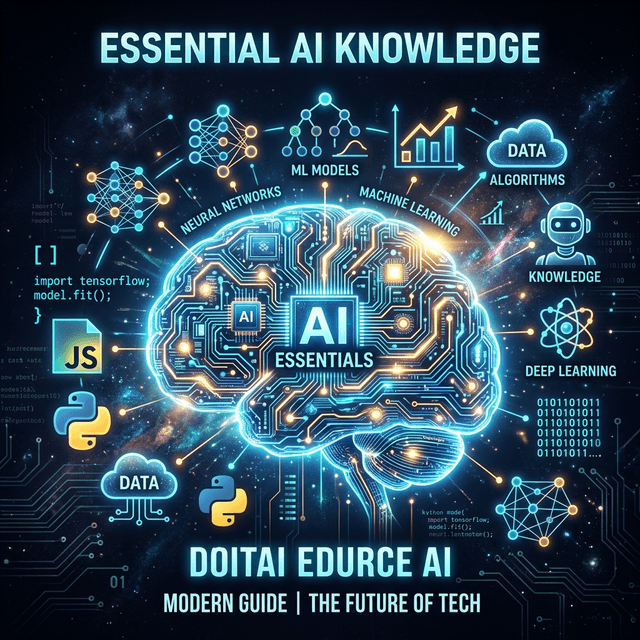
The Essential AI Knowledge Everyone Needs: A Practical Guide for 2026 and Beyond
You don't need a PhD in machine learning to thrive in the AI era, but you do need to understand the fundamentals. This guide covers exactly what every professional must know to stay relevant.

Codmaker
Independent product lab
Why AI Literacy Is No Longer Optional
In 2020, understanding AI was an advantage. In 2023, it was a differentiator. In 2026, it is a requirement. Just as computer literacy became a non-negotiable professional skill in the early 2000s, AI literacy has crossed the threshold from luxury to necessity. Professionals who lack a working understanding of AI capabilities, limitations, and ethical implications are increasingly unable to participate in critical business decisions, collaborate effectively with technical teams, or evaluate the AI-driven products and services that their organizations depend upon.
The good news is that the level of AI understanding required for most professionals is accessible and practical. You do not need to understand the mathematical foundations of transformer architectures or be able to implement a neural network from scratch. You do need to understand what AI can and cannot do, how to evaluate AI tools for your specific use cases, how to interpret AI outputs critically, and how to identify when AI-generated content or recommendations may be biased, incomplete, or dangerously wrong.
The consequences of AI illiteracy are becoming tangible. Professionals who cannot leverage AI tools are measurably less productive than their AI-augmented peers. Managers who do not understand AI capabilities make poor technology investment decisions. Executives who lack AI fluency cannot evaluate AI vendor claims or set realistic expectations for AI initiatives. And all professionals, regardless of their role, risk making ethically questionable decisions when they do not understand how the AI systems they interact with actually work.
This guide is designed to provide the practical AI knowledge that every professional needs—regardless of their technical background. It focuses on understanding, not implementation. The goal is not to turn everyone into a machine learning engineer, but to give everyone the conceptual framework needed to be an effective user, evaluator, and decision-maker in an AI-driven world.
Understanding How AI Actually Works: The Concepts That Matter
At its core, modern AI—specifically the large language models (LLMs) that power tools like ChatGPT, Gemini, and Claude—works through statistical pattern recognition at an extraordinary scale. These models are trained on vast amounts of text data, learning the statistical relationships between words, phrases, concepts, and ideas. When you input a prompt, the model predicts the most likely sequence of tokens (roughly, words) that should follow, based on everything it learned during training.
This has profound implications that every user should understand. First, LLMs do not 'know' anything in the human sense—they have learned patterns that often align with factual accuracy, but they can and do generate plausible-sounding content that is factually incorrect. This phenomenon, known as 'hallucination,' is not a bug but an inherent characteristic of the architecture. Understanding this is crucial: you should never trust AI output without verification for anything where accuracy matters.
Second, AI models have knowledge cutoff dates. They were trained on data available up to a certain point and do not have access to events, discoveries, or changes that occurred after that date unless supplemented with real-time retrieval systems. Third, models have biases that reflect the biases in their training data. If the training data over-represents certain perspectives, cultures, or viewpoints, the model's outputs will reflect those biases. Being able to recognize when an AI response might be biased is an essential critical thinking skill for the AI era.
Beyond LLMs, other forms of AI are equally important to understand. Computer vision systems analyze images and video, powering everything from medical imaging to autonomous vehicles. Recommendation systems use your past behavior to predict your preferences, driving the content you see on social media, streaming platforms, and e-commerce sites. Understanding these systems—even at a high level—allows you to navigate the AI-driven world more effectively and make more informed decisions about the technology you interact with daily.
- LLMs predict text sequences based on statistical patterns—they do not truly 'understand' or 'know' facts
- Hallucination is inherent: always verify AI outputs for factual claims and critical decisions
- Knowledge cutoffs mean models lack awareness of recent events unless connected to retrieval systems
- Training data biases propagate into model outputs—develop the habit of checking for perspective bias
- Computer vision, recommendation engines, and reinforcement learning are equally important AI branches
Practical AI Skills Everyone Should Develop
The most immediately valuable AI skill for any professional is effective tool usage. This means learning to use at least one AI assistant (such as ChatGPT, Gemini, or Claude) for daily work tasks: drafting communications, summarizing documents, brainstorming ideas, analyzing data, and generating first drafts. The key is to develop a practice of iterative refinement—starting with a broad request, evaluating the output, and refining the prompt until you get the quality you need.
Data interpretation is another essential skill. As AI tools generate more analyses, summaries, and recommendations, the ability to critically evaluate these outputs becomes paramount. Can you spot when an AI summary has missed a crucial nuance? Can you recognize when a data visualization generated by AI presents information in a misleading way? Can you identify when an AI recommendation is based on insufficient or biased data? These critical evaluation skills separate effective AI users from passive consumers of AI output.
Understanding AI ethics and responsible usage is no longer just for ethicists and policymakers—it is a practical skill for every professional. Knowing when it is appropriate to use AI-generated content and when it is not, understanding data privacy implications of sharing information with AI systems, recognizing potential biases in AI recommendations, and being transparent about AI usage in professional contexts are all skills that protect both individuals and organizations from legal, reputational, and ethical risks.
Finally, automation thinking—the ability to identify which of your daily tasks could benefit from AI assistance and design effective workflows that combine human and AI work—is becoming a defining characteristic of high-performing professionals. The best AI users do not just use AI for individual tasks; they redesign their entire workflow to optimize the division of labor between human and machine, creating productivity gains that compound over time.
Staying Current: Building an AI Learning Practice
The AI landscape evolves at a pace that makes traditional continuing education models inadequate. A course taken six months ago may already be outdated. The most effective approach to staying current is to build a sustainable learning practice rather than pursue one-time training. This means dedicating a consistent amount of time—even 30 minutes three times per week—to hands-on experimentation with new AI tools and techniques.
Curate a small set of high-quality information sources: follow researchers and practitioners on social media who share practical insights, subscribe to newsletters that summarize AI developments in accessible language, and join communities of practice where professionals share experiences and techniques. Avoid the hype cycle—most breathless announcements about AI breakthroughs have limited practical impact. Focus on understanding which developments actually change what you can do in your daily work.
Build projects, not just knowledge. The fastest way to develop AI fluency is to use AI tools to solve real problems you care about. Automate a tedious aspect of your workflow. Build a personal knowledge management system powered by AI. Create a custom AI assistant fine-tuned for your specific domain. These projects develop practical intuition that no amount of reading can provide and give you concrete examples to discuss with colleagues and potential employers.
Perhaps most importantly, share what you learn. Teaching others is the most effective way to solidify your own understanding, and building a reputation as an AI-literate professional creates career opportunities that would not otherwise exist. Write about your experiments, present findings to your team, and mentor colleagues who are earlier in their AI learning journey. The professionals who will thrive most in the AI era are not just those who learn—they are those who learn and then help others learn, creating multiplier effects that extend their impact far beyond their individual work.
- Dedicate 30 minutes, 3x per week to hands-on AI tool experimentation
- Curate 3-5 high-quality newsletters and follow practical AI practitioners
- Build real projects that solve your actual problems—not just tutorials
- Ignore hype cycles—focus on developments that change what you can actually do
- Share your learnings: teach colleagues, write about experiments, mentor others
- Join communities of practice for peer learning and staying current with trends
Related reading
Mar 14, 2026
Prompt Engineering: The Art and Science of Communicating with AI in 2026
Prompt engineering has emerged as one of the most critical skills in the AI era. Learn how to craft effective prompts, understand token economics, and master the techniques that separate amateurs from experts.
Mar 10, 2026
The Jobs of the Future: How AI Is Creating (Not Just Destroying) the Careers of Tomorrow
While headlines focus on job displacement, the reality is far more nuanced. New roles are emerging, existing roles are transforming, and the professionals who adapt will thrive in ways previous generations could never imagine.

Mar 30, 2026
AI in Cybersecurity: How Automated Threat Detection and Response Is Transforming Digital Defense in 2026
Cyberattacks are faster, smarter, and more frequent than ever. AI-powered cybersecurity systems are the only defense capable of matching the speed and sophistication of modern threats. Here is how AI is reshaping digital security.