
The Jobs of the Future: How AI Is Creating (Not Just Destroying) the Careers of Tomorrow
While headlines focus on job displacement, the reality is far more nuanced. New roles are emerging, existing roles are transforming, and the professionals who adapt will thrive in ways previous generations could never imagine.

Codmaker
Independent product lab
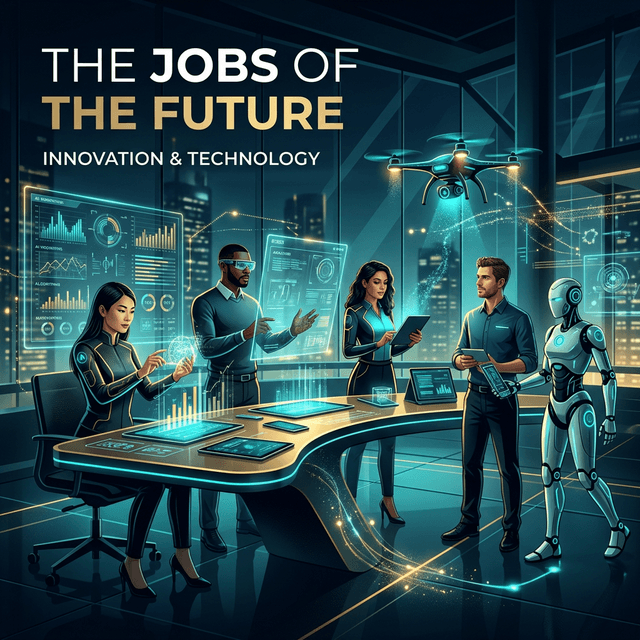
Beyond the Displacement Narrative
Every technological revolution in history has triggered waves of anxiety about job displacement. The introduction of the printing press, the steam engine, the assembly line, and the personal computer all provoked fears that human labor would become obsolete. In every case, while specific roles were indeed eliminated, entirely new categories of work emerged that were unimaginable before the technology existed. The AI revolution follows this pattern, but with unique characteristics that make the transition both faster and more transformative than any that came before.
The World Economic Forum estimates that AI will displace approximately 85 million jobs globally by 2027, but simultaneously create 97 million new ones. The net effect is positive, but the transition is uneven. Roles that involve routine data processing, basic content creation, and repetitive analysis are declining. Roles that involve human judgment, creativity, emotional intelligence, complex problem-solving, and AI oversight are growing rapidly. The key variable is not whether your job will be affected—it will be—but whether you position yourself on the creating side of the equation.
What makes the current transformation unique is its speed and the breadth of roles affected. Previous technological shifts primarily impacted blue-collar and manufacturing roles. AI affects white-collar knowledge work—accounting, legal research, medical diagnostics, software development, marketing, and journalism. For the first time, professionals with advanced degrees and decades of experience find their core tasks being automated, creating an urgent need for adaptation across the entire economy.
The professionals who thrive in this environment share common traits: they view AI as a force multiplier rather than a threat, they continuously invest in learning new tools and techniques, they focus on developing skills that complement rather than compete with AI, and they embrace hybrid roles that combine traditional expertise with AI proficiency. The career winners of the next decade will not be those who resist AI or those who blindly adopt it, but those who strategically integrate it into their professional practice.
Emerging Roles: The Jobs That Didn't Exist Five Years Ago
The emergence of generative AI has spawned entirely new job categories at a breathtaking pace. AI Ethics Officers are now required at any organization deploying large-scale AI systems, responsible for auditing models for bias, ensuring regulatory compliance, and establishing governance frameworks. This role barely existed before 2023 and is now one of the fastest-growing executive positions in technology, with senior AI Ethics Officers commanding salaries above $250,000.
AI Trainers and RLHF Specialists work directly on improving model behavior through reinforcement learning from human feedback. They create evaluation criteria, rate model outputs, identify failure modes, and provide the human judgment that guides model improvement. This role requires a unique combination of domain expertise, analytical thinking, and attention to nuance that makes it inherently resistant to automation—you need humans to teach AI what good human communication looks like.
Synthetic Media Producers create and manage AI-generated content—from marketing images and product photography to personalized video content and voice synthesis. This role combines traditional creative direction with technical AI tool proficiency. The best synthetic media producers understand both the artistic principles of composition, color theory, and storytelling, and the technical parameters that control AI generation quality.
AI Integration Architects design and implement the systems that connect AI capabilities with existing business processes. Unlike traditional software engineers, they must understand both the technical APIs and the organizational change management required to successfully deploy AI tools. They work at the intersection of technology, process design, and organizational psychology, making this one of the most complex and valuable emerging roles.
Data Curators and Knowledge Managers have also seen explosive growth. As organizations realize that the quality of their AI outputs depends on the quality of their data, professionals who can organize, clean, label, and maintain high-quality datasets have become invaluable. This role requires a blend of domain expertise, data literacy, and project management skills.
- AI Ethics Officer: Governance, bias auditing, regulatory compliance — $200K-$300K+
- AI Trainer / RLHF Specialist: Human feedback for model improvement — inherently automation-resistant
- Synthetic Media Producer: AI-generated content creation with creative direction
- AI Integration Architect: Connecting AI capabilities with business processes and workflows
- Data Curator: Organizing and maintaining high-quality datasets for AI systems
- Prompt Engineer: Designing and optimizing AI interactions — $140K-$220K
- AI Safety Researcher: Ensuring AI systems behave reliably and safely at scale
Transforming Existing Roles: The AI-Augmented Professional
Perhaps more significant than entirely new roles is the transformation of existing ones. The doctor of 2026 does not simply diagnose based on symptoms and experience—they collaborate with AI systems that have analyzed millions of similar cases, flag potential drug interactions, and suggest treatment protocols based on the latest research. The doctor's value has shifted from memorization and pattern recognition to judgment, patient communication, and the ability to critically evaluate AI recommendations.
Software engineers have undergone a similar transformation. The engineer who spends their day writing boilerplate code from scratch is rapidly becoming obsolete. The AI-augmented engineer uses AI assistants to generate code, then applies their expertise to architecture decisions, system design, code review, and the kind of creative problem-solving that AI cannot yet replicate. The best engineers report that AI has freed them from drudgery and allowed them to focus on the intellectually stimulating aspects of their work.
Teachers are evolving from content deliverers to learning facilitators. With AI capable of providing personalized instruction, practice problems, and instant feedback, the human teacher's role is shifting toward mentorship, motivation, social-emotional learning, and the kind of inspirational education that requires genuine human connection. Teachers who embrace AI tools report being able to give every student the equivalent of one-on-one tutoring, dramatically improving learning outcomes.
The pattern across these transformations is consistent: AI handles the routine, data-intensive, and pattern-matching aspects of work, while humans focus on judgment, creativity, empathy, leadership, and strategic thinking. Professionals who position themselves on the human side of this divide—while being fluent in AI tools—will find their careers not just surviving but thriving in ways that would have been impossible without AI assistance.
Preparing for the Future: Skills That Will Matter Most
The skills that will define career success in the AI era can be organized into three categories: AI fluency, distinctly human skills, and adaptive capacity. AI fluency means understanding how AI tools work, when to use them, and when to override them. This does not require a Ph.D. in machine learning—it requires practical experience with AI tools, an understanding of their capabilities and limitations, and the judgment to know when AI output needs human verification.
Distinctly human skills—creativity, emotional intelligence, ethical reasoning, leadership, and complex communication—become more valuable as AI handles routine tasks. The ability to inspire a team, navigate organizational politics, build trust with clients, make judgment calls under uncertainty, and communicate complex ideas to diverse audiences cannot be replicated by current AI systems. These skills, long considered 'soft,' are now the hardest to automate and therefore the most career-resilient.
Adaptive capacity—the ability to learn new tools, pivot to new roles, and continuously evolve—may be the most important meta-skill of all. The specific AI tools and techniques that are cutting-edge today will be obsolete within three to five years. The professional who built their career around mastering one specific tool will struggle, while the one who built their career around the ability to rapidly master any new tool will thrive regardless of how the technology landscape shifts.
The practical advice for professionals at any career stage is clear: invest time every week in learning AI tools relevant to your field, develop a habit of continuous experimentation, build a network of other AI-forward professionals, and focus on developing the human skills that distinguish you from both AI and from other professionals who are not adapting. The future belongs to those who actively prepare for it.
- AI Fluency: Practical tool proficiency, understanding capabilities and limitations
- Creativity: Generating novel solutions, creative direction, and original thinking
- Emotional Intelligence: Empathy, leadership, team building, and client relationships
- Critical Thinking: Evaluating AI outputs, making judgment calls, ethical reasoning
- Adaptive Capacity: Continuous learning, tool-agnostic skill development, rapid pivoting
- Communication: Explaining complex ideas to diverse audiences across disciplines
Related reading
Mar 14, 2026
Prompt Engineering: The Art and Science of Communicating with AI in 2026
Prompt engineering has emerged as one of the most critical skills in the AI era. Learn how to craft effective prompts, understand token economics, and master the techniques that separate amateurs from experts.
Mar 6, 2026
The Essential AI Knowledge Everyone Needs: A Practical Guide for 2026 and Beyond
You don't need a PhD in machine learning to thrive in the AI era, but you do need to understand the fundamentals. This guide covers exactly what every professional must know to stay relevant.

Mar 30, 2026
AI in Cybersecurity: How Automated Threat Detection and Response Is Transforming Digital Defense in 2026
Cyberattacks are faster, smarter, and more frequent than ever. AI-powered cybersecurity systems are the only defense capable of matching the speed and sophistication of modern threats. Here is how AI is reshaping digital security.