
Advanced Prompting Techniques: System Prompts, Meta-Prompting, and Prompt Chains That Actually Work
Move beyond basic prompting. This deep dive covers system prompt architecture, meta-prompting strategies, multi-step prompt chains, and the advanced patterns used by professional AI engineers to get consistently excellent results.

Codmaker
Independent product lab
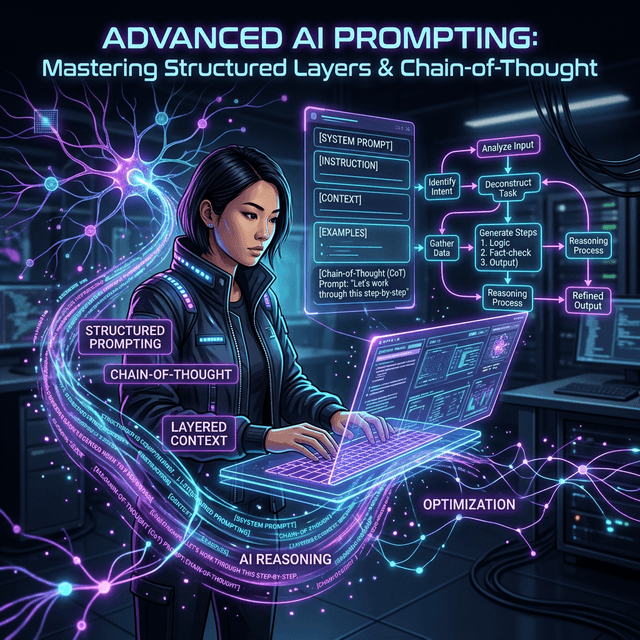
Meta-Prompting: Teaching AI to Prompt Itself
Meta-prompting is the practice of using AI to generate, evaluate, and optimize prompts—effectively teaching the machine to prompt itself. This technique has emerged as one of the most powerful tools in the advanced prompt engineer's arsenal. Instead of manually iterating through dozens of prompt variations, a meta-prompt instructs the AI to generate multiple prompt candidates, evaluate them against defined criteria, and synthesize the best elements into an optimized final prompt.
The most effective meta-prompting workflow follows three stages. First, the 'prompt generation' stage: you describe your goal and ask the AI to generate 5-10 different prompts that could achieve it, each using different techniques (few-shot, chain-of-thought, persona-based, etc.). Second, the 'evaluation' stage: you ask the AI to score each generated prompt against criteria like clarity, specificity, likelihood of producing accurate results, and robustness to edge cases. Third, the 'synthesis' stage: you ask the AI to combine the strongest elements of the top-rated prompts into a single, optimized prompt.
Self-reflection prompting is a related technique where you ask the AI to critique its own output before delivering a final response. A simple addition like 'Before answering, identify three potential flaws in your reasoning and address them' can dramatically improve output quality. This activates a form of internal dialogue that catches errors, addresses ambiguities, and produces more nuanced, thoughtful responses.
Meta-prompting is particularly valuable for creating reusable prompt templates. Rather than crafting individual prompts for each task, you can use meta-prompting to develop robust templates with variable placeholders that work consistently across a wide range of inputs. These templates become intellectual property—valuable assets that encode your domain expertise and prompting skill into portable, shareable formats that maintain quality even when used by less experienced team members.
Prompt Chains: Building Multi-Step AI Workflows
Single prompts have inherent limitations. Complex tasks—writing a research report, debugging a system, analyzing a dataset—require multiple reasoning steps that exceed what any single prompt can reliably accomplish. Prompt chains solve this by decomposing complex tasks into a sequence of simpler, focused prompts, where the output of each step becomes the input for the next. This 'divide and conquer' approach mirrors how humans tackle complex problems and consistently outperforms monolithic prompts.
A well-designed prompt chain for content creation might look like this: Step 1 generates a detailed outline. Step 2 evaluates the outline for completeness and logical flow. Step 3 expands each section with detailed content. Step 4 reviews the complete draft for consistency and quality. Step 5 generates a final polish pass focusing on style and readability. Each step uses a focused prompt optimized for its specific task, producing results far superior to asking the AI to 'write a complete article about X.'
Branching chains add conditional logic: based on the output of one step, the chain follows different paths. For example, a code review chain might first analyze code complexity. If complexity is high, it branches to a detailed architecture review. If complexity is low but test coverage is poor, it branches to test generation. This creates adaptive workflows that handle diverse inputs intelligently without requiring human intervention at every decision point.
The technical implementation of prompt chains ranges from simple scripts that pipe outputs between API calls to sophisticated orchestration frameworks like LangChain, LlamaIndex, and custom-built pipelines. The choice depends on complexity: simple linear chains work fine with a Python script, while branching chains with parallel execution, error recovery, and state management benefit from purpose-built frameworks. Regardless of implementation, the key principle is the same: break complex tasks into focused subtasks that AI can handle reliably.
- Prompt chains outperform monolithic prompts for any task requiring 3+ reasoning steps
- Linear chains: output of step N becomes input for step N+1—simple but powerful
- Branching chains add conditional logic for adaptive, intelligent workflows
- Frameworks: LangChain, LlamaIndex, or custom scripts for orchestration
- Each chain step should have its own focused system prompt optimized for that specific subtask
- Always include a validation step before the final output to catch upstream errors
Production-Grade Prompting: Reliability at Scale
Moving prompts from experimentation to production introduces challenges that many engineers underestimate. In a production environment, prompts must be reliable across thousands of diverse inputs, not just the handful of test cases used during development. This requires adversarial testing—deliberately feeding the prompt edge cases, ambiguous inputs, and adversarial inputs designed to break it. Prompts that work 95% of the time in testing often fail 20-30% of the time in production when exposed to the full diversity of real-world inputs.
Version control for prompts is essential in production environments. Prompts should be stored in version-controlled repositories with clear changelogs explaining why each modification was made. Just like code, prompts should go through review processes before deployment. A/B testing frameworks allow teams to compare prompt versions against each other using real traffic, measuring not just output quality but also latency, cost, and user satisfaction.
Observability is the third pillar of production prompting. Every prompt execution should be logged with sufficient detail to diagnose failures: the input, the complete prompt (including system prompt), the raw output, any post-processing applied, and quality metrics. This telemetry enables teams to identify degradation patterns, debug edge cases, and continuously improve prompt performance over time.
Cost management becomes critical at scale. A prompt that costs $0.05 per execution is negligible for personal use but represents $50,000 per month at one million daily executions. Production prompt engineers must optimize for token efficiency without sacrificing quality—using techniques like prompt compression, dynamic context selection (only including relevant context rather than dumping everything), and response length limits. The best teams establish cost budgets per prompt and continuously optimize to stay within them while maintaining or improving quality.
Related reading

Mar 14, 2026
Prompt Engineering: The Art and Science of Communicating with AI in 2026
Prompt engineering has emerged as one of the most critical skills in the AI era. Learn how to craft effective prompts, understand token economics, and master the techniques that separate amateurs from experts.

Mar 30, 2026
AI in Cybersecurity: How Automated Threat Detection and Response Is Transforming Digital Defense in 2026
Cyberattacks are faster, smarter, and more frequent than ever. AI-powered cybersecurity systems are the only defense capable of matching the speed and sophistication of modern threats. Here is how AI is reshaping digital security.

Mar 13, 2026
GPT vs Gemini vs Claude vs Llama: The Definitive AI Model Comparison for 2026
Not all AI models are created equal. This comprehensive comparison breaks down the strengths, weaknesses, pricing, and ideal use cases for every major AI model available today.