
GPT vs Gemini vs Claude vs Llama: The Definitive AI Model Comparison for 2026
Not all AI models are created equal. This comprehensive comparison breaks down the strengths, weaknesses, pricing, and ideal use cases for every major AI model available today.

Codmaker
Independent product lab
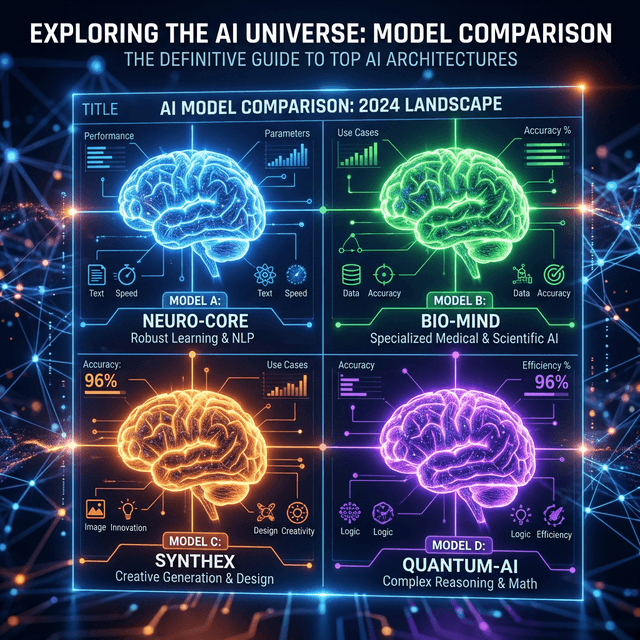
The AI Model Landscape in 2026
The AI model landscape has never been more competitive or more confusing. In 2023, GPT-4 was the undisputed champion. By 2026, multiple models have reached and exceeded that benchmark, each with distinct strengths that make them optimal for different use cases. Understanding these differences is no longer academic—it directly impacts productivity, cost, and output quality for anyone relying on AI in their professional workflow.
The major contenders can be grouped into three categories. Proprietary frontier models—OpenAI's GPT-4o and o1, Google's Gemini 2.0, and Anthropic's Claude 3.5 Sonnet and Opus—offer the highest raw capability but come with usage costs and data privacy considerations. Open-source models—Meta's Llama 3.1, Mistral's Large, and Alibaba's Qwen 2.5—offer flexibility, privacy, and cost advantages for organizations willing to host their own infrastructure. Specialized models—optimized for specific tasks like code generation, medical analysis, or multilingual translation—excel in narrow domains but lack general versatility.
Choosing the right model is not about finding the 'best' one—it is about matching model characteristics to your specific requirements. A coding assistant needs strong code generation and debugging capabilities. A customer service chatbot needs conversational fluency and safety guardrails. A research tool needs accuracy, citation capability, and long-context handling. The model that excels at one task may underperform at another.
This comparison focuses on practical, measurable differences rather than hype. We evaluate each model family across six dimensions: reasoning quality, code generation, creative writing, instruction following, context window size, and cost efficiency. Our goal is to give you the information needed to make an informed choice for your specific use case.
OpenAI GPT-4o and o1: The Versatile Powerhouse
OpenAI's GPT-4o represents the refinement of the model that started the generative AI revolution. Its greatest strength is versatility—it performs well across virtually every task category, from creative writing to code generation to data analysis. For teams that need one model to handle diverse tasks, GPT-4o remains a compelling default choice. The model's instruction following is excellent, its knowledge base is broad, and its API ecosystem is the most mature in the industry.
The o1 family of models (o1, o1-mini, o1-pro) represents a different approach: extended reasoning. These models 'think' before answering, spending additional compute on complex problems. For mathematical reasoning, scientific analysis, and multi-step logical problems, o1 significantly outperforms all other models. However, this thinking comes at a cost—both in latency (responses take 10-60 seconds) and price (roughly 3-6x more expensive per token than GPT-4o).
The OpenAI ecosystem is another advantage. The Assistants API, function calling, file analysis, vision capabilities, and the extensive third-party integration ecosystem make it easy to build sophisticated applications. The developer experience is polished, documentation is comprehensive, and the community is enormous—meaning solutions to common problems are usually a search away.
Weaknesses include occasional verbosity (GPT models tend to generate longer responses than necessary), sensitivity to prompt phrasing (small changes in wording can produce significantly different outputs), and ongoing concerns about data privacy—since inputs are processed on OpenAI's servers. For organizations with strict data governance requirements, this remains a significant consideration that may override GPT's technical strengths.
- GPT-4o: Best all-rounder, excellent instruction following, mature ecosystem
- o1 family: Superior reasoning for math/science/logic, but 3-6x more expensive and slower
- Strongest ecosystem: Assistants API, function calling, vision, largest integration library
- Weaknesses: verbosity, prompt sensitivity, data privacy concerns for sensitive workloads
- Best for: teams needing versatility across diverse tasks with minimal setup
Anthropic Claude: The Safety-First Reasoning Engine
Anthropic's Claude models have carved out a distinctive position in the AI landscape. Claude 3.5 Sonnet, the company's flagship model, matches or exceeds GPT-4o on most benchmarks while offering a noticeably different character: responses tend to be more measured, nuanced, and willing to express uncertainty. For tasks requiring careful analysis, balanced perspectives, and thoughtful reasoning, Claude often produces superior results.
Claude's standout feature is its massive 200,000-token context window—large enough to process an entire novel, a complete codebase, or hundreds of pages of legal documents in a single interaction. This capability transforms use cases that were previously impossible: analyzing an entire repository for architectural patterns, summarizing a complete legal contract, or maintaining coherent conversation across extremely long interactions. While other models have expanded their context windows, Claude's long-context performance remains consistently the strongest.
The safety and alignment characteristics of Claude are genuinely differentiated. The model is less likely to generate harmful, biased, or misleading content compared to competitors. It handles sensitive topics with nuance rather than simply refusing to engage. For organizations in regulated industries—healthcare, finance, legal—where AI outputs carry compliance implications, Claude's safety profile is a significant advantage.
Claude's weaknesses include a smaller integration ecosystem compared to OpenAI (though this gap is closing rapidly), occasional over-cautiousness that leads to unnecessary refusals or excessive caveats, and the fact that Anthropic does not offer as many model variants optimized for specific tasks. The API is well-designed and developer-friendly, and the introduction of tool use and computer control capabilities has significantly expanded Claude's practical utility.
- Claude 3.5 Sonnet: exceptional reasoning, nuanced analysis, with 200K token context window
- Industry-leading long-context performance for document analysis and codebase review
- Safety-first design: less harmful outputs, better handling of sensitive topics
- Best for: analysis, research, document processing, regulated industries, code review
- Weaknesses: smaller ecosystem, occasional over-cautiousness, fewer specialized variants
Google Gemini, Meta Llama, and the Open-Source Revolution
Google's Gemini 2.0 models are notable for their native multimodal capabilities. While other models process text and images through separate pipelines, Gemini was designed from the ground up to process text, images, video, and audio in a unified architecture. This makes it particularly strong for tasks that involve reasoning across modalities—analyzing a video and providing written commentary, understanding diagrams in technical documents, or processing audio recordings alongside text transcripts.
Gemini's integration with Google's ecosystem is a major advantage for organizations already using Google Cloud, Workspace, or Android. Deep integration with Google Search provides grounding capabilities that reduce hallucination by verifying claims against real-time web content. The Gemini 1.5 Pro model offers a million-token context window—currently the largest commercially available—enabling analysis of enormous documents that exceed even Claude's substantial context capacity.
Meta's Llama 3.1 represents the pinnacle of open-source AI. Available in 8B, 70B, and 405B parameter versions, Llama models can be downloaded, modified, and deployed on your own infrastructure with no per-token cost and complete data privacy. The 405B model approaches frontier performance on most benchmarks, while the smaller variants offer excellent quality-to-cost ratios for organizations with GPU infrastructure. The open-source community around Llama has produced thousands of fine-tuned variants optimized for specific domains and languages.
The choice between proprietary and open-source models involves fundamental tradeoffs. Proprietary models offer higher raw performance, simpler deployment, and less operational burden. Open-source models offer data privacy, cost control at scale, the ability to fine-tune for specific domains, and freedom from vendor lock-in. Many sophisticated organizations use a hybrid approach: open-source models for high-volume, cost-sensitive tasks and proprietary models for complex, accuracy-critical work where the higher per-token cost is justified by superior output quality.
- Gemini 2.0: native multimodal (text + image + video + audio), million-token context window
- Google ecosystem integration: Search grounding reduces hallucination with real-time verification
- Llama 3.1 405B: frontier-level open-source, deploy on your own infrastructure with zero per-token cost
- Hybrid approach recommended: open-source for volume, proprietary for accuracy-critical tasks
- Mistral Large, Qwen 2.5, and DeepSeek also offer competitive open-source alternatives
Related reading

Mar 30, 2026
AI in Cybersecurity: How Automated Threat Detection and Response Is Transforming Digital Defense in 2026
Cyberattacks are faster, smarter, and more frequent than ever. AI-powered cybersecurity systems are the only defense capable of matching the speed and sophistication of modern threats. Here is how AI is reshaping digital security.
Mar 9, 2026
Why n8n Is the Best Workflow Automation Platform: Advantages Over Zapier, Make, and Others
Open-source, self-hostable, code-flexible, and AI-native — n8n offers fundamental advantages that closed-source automation platforms cannot match. Here is why technical teams are switching.
Mar 15, 2026
Advanced Prompting Techniques: System Prompts, Meta-Prompting, and Prompt Chains That Actually Work
Move beyond basic prompting. This deep dive covers system prompt architecture, meta-prompting strategies, multi-step prompt chains, and the advanced patterns used by professional AI engineers to get consistently excellent results.