
Why n8n Is the Best Workflow Automation Platform: Advantages Over Zapier, Make, and Others
Open-source, self-hostable, code-flexible, and AI-native — n8n offers fundamental advantages that closed-source automation platforms cannot match. Here is why technical teams are switching.

Codmaker
Independent product lab
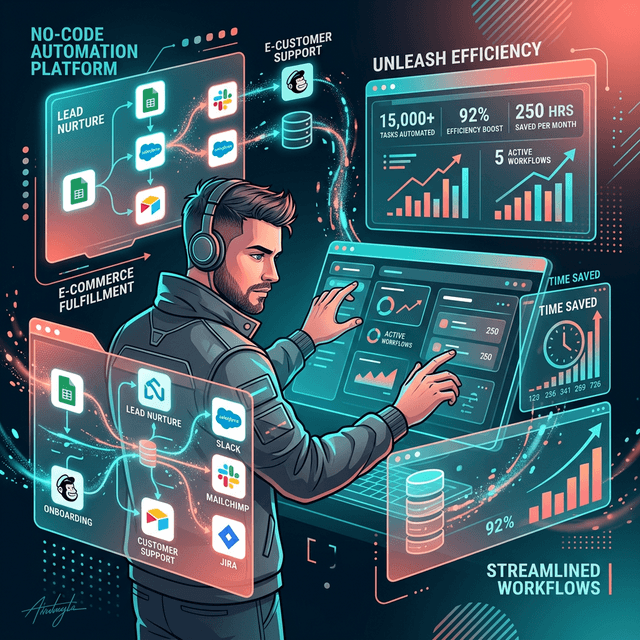
Open Source and Self-Hosted: Own Your Automation Infrastructure
The most fundamental advantage of n8n over platforms like Zapier, Make (formerly Integromat), and Power Automate is that n8n is open source and can be self-hosted. This is not just a philosophical distinction—it has profound practical implications. When you self-host n8n, your workflow data, credentials, and execution logs never leave your infrastructure. For organizations handling sensitive data—healthcare records, financial transactions, legal documents, or proprietary business logic—this eliminates an entire category of compliance and security concerns.
Self-hosting also eliminates per-execution pricing, which is the model used by Zapier and Make. On those platforms, every workflow trigger costs money—and as your automation scales, costs can grow exponentially. A workflow that processes 10,000 events per day might cost hundreds or thousands of dollars per month on Zapier. On self-hosted n8n, the same workflow runs on your infrastructure with no per-execution fees. You pay only for the server resources, which are a fraction of the SaaS cost at scale.
The open-source nature of n8n means you can inspect, modify, and extend the platform itself. If a built-in node does not work exactly as you need, you can fork it and customize it. If you need a node for an internal service that no automation platform supports, you can build one using n8n's well-documented Node Development Kit. This level of customization is simply impossible with closed-source platforms where you are entirely dependent on the vendor's roadmap.
For teams that want the benefits of cloud hosting without the operational burden, n8n Cloud provides a managed SaaS experience. But even on the cloud plan, n8n's pricing is significantly more generous than competitors—with higher execution limits, no artificial restrictions on workflow complexity, and the ability to migrate to self-hosted at any time without losing your workflows. There is no vendor lock-in because the platform is open source.
Code When You Need It: The Best of Both Worlds
Every automation platform claims to be 'easy to use,' but there is an inherent tension between simplicity and power. Zapier optimizes for simplicity—anyone can build a basic automation, but the moment you need conditional logic, data transformation, or custom API handling, you hit walls. Make offers more power through its visual data mapping, but complex transformations still feel like fighting the tool. n8n resolves this tension elegantly: build visually when it is faster, drop into code when you need precision.
The Code node in n8n gives you full access to JavaScript or Python within any workflow step. This is not a limited scripting environment like Zapier's Code by Zapier step—it is a full runtime where you can import npm packages, make HTTP requests, access the file system, and execute arbitrary logic. A single Code node can replace dozens of visual nodes for complex data transformations, and the output flows seamlessly back into the visual workflow for subsequent steps.
This hybrid approach is particularly powerful for AI workflows. You can use visual nodes for standard operations (triggers, integrations, notifications) and Code nodes for the complex parts that require custom logic: preprocessing data for AI models, parsing structured outputs, implementing retry logic with exponential backoff, or aggregating results from multiple AI calls. The visual canvas gives you the big-picture overview while code handles the details.
For development teams, n8n's developer experience is mature and professional. Workflows are stored as JSON and can be version-controlled with Git. The platform supports isolated environments for development, staging, and production, with workflow diffs that show exactly what changed between versions. You can export workflows, share them with teammates, and import community-created templates—all through a Git-compatible workflow that integrates with your existing DevOps practices.
- Visual builder for speed + JavaScript/Python code for power—best of both worlds
- Full runtime Code node: import npm packages, access file system, arbitrary logic
- AI workflows benefit most: visual for orchestration, code for complex data processing
- Git-based version control: workflow diffs, isolated environments, team collaboration
- Export/import workflows as JSON: no vendor lock-in, easy sharing and backup
AI-Native Capabilities: Built for the Agent Era
While Zapier and Make have added AI features as afterthoughts, n8n was rebuilt with AI at its core. The platform provides native nodes for all major AI providers—OpenAI, Anthropic, Google, Hugging Face, and self-hosted models via Ollama. But the real advantage is not just API connectivity; it is the infrastructure for building production AI systems: agent architectures with tool use, vector store integrations for RAG, evaluations for testing AI accuracy, and human-in-the-loop approval workflows.
n8n's AI Agent node implements a full reasoning loop: the agent receives a task, reasons about what tools to use, executes tools (which are other n8n workflows), observes results, and iterates until the task is complete. The visual canvas shows every step of this reasoning process in real time, making it possible to understand and debug AI behavior in ways that are impossible with black-box AI tools. When an agent makes a wrong decision, you can see exactly where and why, then adjust the system prompt or tool configuration.
Evaluations are a standout feature that competitors lack entirely. n8n lets you define test cases for your AI workflows—input/expected output pairs—and run them automatically to measure accuracy, detect regressions, and optimize performance. This is essential for production AI systems where you need confidence that changes to prompts, models, or data do not degrade output quality. Combined with human-in-the-loop approvals, evaluations create a quality assurance framework that makes AI workflows production-safe.
The AI governance features are designed for enterprise adoption. Guardrails can be configured to prevent AI from taking certain actions without human approval. Audit logs track every AI decision for compliance review. The ability to self-host means AI processing happens on your infrastructure—no data leaves your control. For organizations in regulated industries where AI governance is a board-level concern, n8n provides the controls that make AI deployment feasible and auditable.
Community, Ecosystem, and Real-World Results
n8n's community of over 200,000 members is one of the largest and most active in the automation space. The community forum is a treasure trove of workflow templates, troubleshooting guides, and creative use cases. New users can browse thousands of pre-built workflow templates that cover common automation scenarios—from lead nurturing and customer onboarding to DevOps monitoring and content publishing. These templates serve as both ready-to-use solutions and learning resources.
The ecosystem extends beyond the core platform. n8n's Node Development Kit allows developers to create custom integration nodes and share them with the community. The API is well-documented and supports embedding n8n workflows into other applications. Webhook triggers enable event-driven architectures where external systems can invoke n8n workflows. This openness creates a virtuous cycle: the more people use n8n, the more integrations and templates become available, which attracts more users.
Real-world results speak convincingly. Huel, the nutrition company, built an AI-first company culture using n8n and saved 1,000 hours of manual work. Vodafone revolutionized their threat intelligence operations and saved £2.2 million. These are not small companies running toy automations—they are enterprises deploying n8n for mission-critical workflows at scale, choosing it over expensive enterprise automation platforms because of its flexibility, transparency, and cost efficiency.
For individuals and small teams, n8n democratizes automation that was previously accessible only to organizations with dedicated integration teams. A solo developer can build a workflow that monitors their GitHub repositories, summarizes new issues with AI, creates Jira tickets, and notifies the team on Slack—all in 30 minutes. A marketing team can automate their entire lead nurturing pipeline without writing a single line of code (but with the option to add code when the logic gets complex). The platform scales from personal productivity tools to enterprise-grade automation infrastructure, growing with your needs without requiring a platform migration.
- 200,000+ community members with thousands of shared workflow templates
- Custom node development: build and share integrations for any service
- Enterprise proven: Huel (1,000 hours saved), Vodafone (£2.2M saved)
- Scales from personal projects to enterprise infrastructure without platform changes
- Free tier available for cloud, unlimited self-hosted deployment at no per-execution cost
- AI-native design: not an afterthought, but core to the platform architecture
Related reading
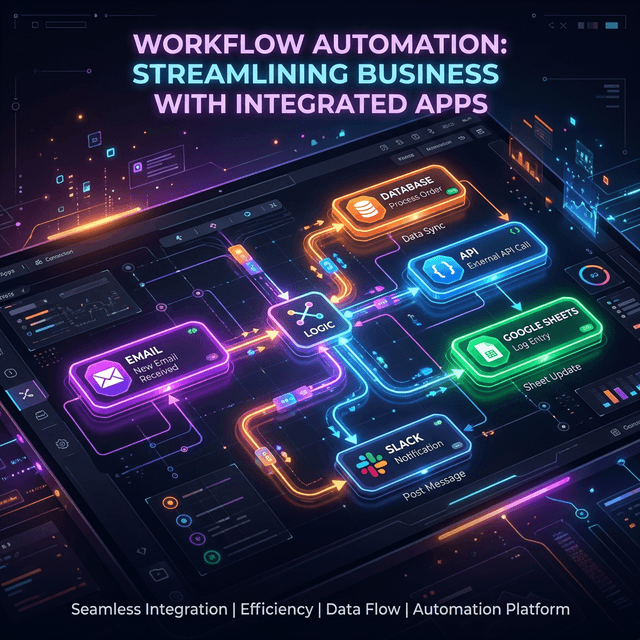
May 17, 2026
n8n Workflow Automation: Build, Scale, Self-Host in 2026
n8n workflow automation done right — visual building, code when you need it, AI agents, and self-hosting cost math. The 2026 engineer's playbook.

Apr 5, 2026
AI-Powered Workflow Automation in 2026: The Trends Reshaping How Businesses Operate
From intelligent document processing to autonomous decision engines, AI-driven workflow automation is eliminating manual tasks at an unprecedented pace. Here is what every business leader and developer needs to know about the trends defining 2026.

Apr 2, 2026
No-Code AI Platforms in 2026: How Non-Developers Are Building Intelligent Applications
The barrier between idea and AI-powered application has never been lower. No-code AI platforms are enabling business analysts, marketers, and entrepreneurs to build sophisticated intelligent applications without writing a single line of code.