
The Advantages of Claude AI: Why More Teams Are Switching to Anthropic's AI Assistant
From its industry-leading context window to its safety-first design philosophy, Claude offers unique advantages that are making it the AI assistant of choice for developers, researchers, and businesses.

Codmaker
Independent product lab
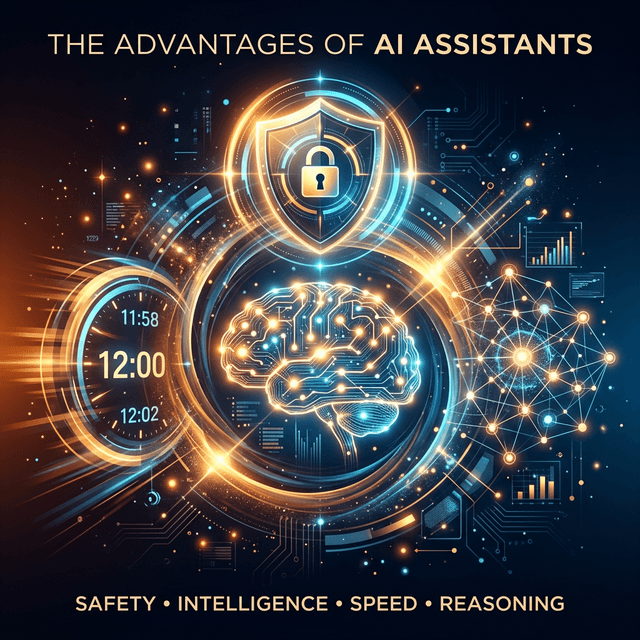
The 200K Context Window: A Game-Changing Advantage
Claude's 200,000-token context window is not just a bigger number—it fundamentally changes what is possible in a single AI interaction. While other models compress, truncate, or lose coherence with long inputs, Claude maintains solid understanding across the equivalent of roughly 150,000 words—an entire book or a substantial codebase. This transforms workflows that were previously impossible without breaking content into multiple separate interactions with the inevitable loss of cross-referential understanding.
For software developers, this means uploading an entire project's source code and asking Claude to analyze architectural patterns, find potential bugs that span multiple files, or understand complex data flows across the application. For legal professionals, it means analyzing a complete contract rather than summarizing it piece by piece. For researchers, it means processing entire papers and synthesizing findings in a single coherent analysis.
The practical impact is dramatic. Teams report that tasks which previously required hours of manual decomposition and re-assembly—breaking documents into chunks, processing each separately, and then manually synthesizing the results—can now be accomplished in a single interaction. This is not just faster; it produces better results because the AI has access to the complete context and can identify connections and patterns that would be invisible in a chunked approach.
Long-context performance is where Claude truly differentiates. Independent benchmarks consistently show that Claude maintains higher accuracy and coherence at 100K+ tokens than any other commercially available model. This is particularly important for tasks like 'needle in a haystack' retrieval—finding a specific piece of information within a massive document—where models with lower attention quality degrade rapidly as context length increases.
Safety and Accuracy: The Trust Factor
In a landscape where AI hallucination is a persistent concern, Claude's safety-first design philosophy provides a meaningful advantage for professional use. Anthropic's Constitutional AI training methodology produces a model that is measurably more likely to acknowledge uncertainty, refuse to fabricate information, and provide balanced perspectives on controversial topics. For organizations where AI outputs flow into customer-facing products, internal reports, or decision-support systems, this reliability is not a nice-to-have—it is a business requirement.
Claude's handling of sensitive topics demonstrates genuine nuance. Rather than simply blocking requests that touch on controversial subjects (a pattern common in overly restrictive models), Claude engages thoughtfully—providing balanced information, acknowledging multiple perspectives, and flagging areas of genuine uncertainty. This makes it particularly valuable for research, journalism, ethical analysis, and any domain where oversimplified answers are worse than no answer at all.
The reduction in harmful outputs has measurable business impact. Organizations using Claude for customer service report fewer incidents where AI responses created support escalations or brand risk. Development teams using Claude for code generation report fewer instances where generated code contained security vulnerabilities or anti-patterns. Healthcare organizations using Claude for research assistance report greater confidence in the accuracy and appropriateness of AI-generated summaries.
Anthropic's transparent approach to model limitations also builds trust. The company publishes detailed model cards, acknowledges known weaknesses, and actively communicates about safety research. For enterprise procurement teams evaluating AI vendors, this transparency provides the confidence needed to deploy AI at scale in sensitive environments where the consequences of AI failures extend beyond mere inconvenience.
Developer Experience and API Quality
Claude's API is widely praised for its clean design, consistent behavior, and straightforward documentation. The Messages API follows a clear, intuitive structure that makes it easy to build applications—from simple chatbots to complex multi-step workflows. Response streaming is well-implemented, tool use (function calling) is reliable, and error messages are informative rather than cryptic.
The introduction of Claude Projects on the web interface has been a significant productivity boost. Projects allow users to define persistent system prompts, upload reference documents, and maintain context across conversations. For a developer working on a specific codebase, a Project can contain the entire repository, coding standards, architectural documentation, and project-specific instructions—creating an AI assistant that truly understands your project without requiring you to re-explain context in every conversation.
Claude's tool use capabilities enable sophisticated integrations. You can define custom tools that Claude can invoke during conversations—searching databases, calling APIs, executing calculations, or triggering workflows. This transforms Claude from a text-in/text-out system into an AI agent that can take real actions in your systems, orchestrated through natural language instructions. The tool use implementation is reliable and well-documented, making it accessible even to developers new to AI integration.
Pricing is competitive and transparent. Claude 3.5 Sonnet costs $3 per million input tokens and $15 per million output tokens—significantly less than comparable models from OpenAI. For teams processing large volumes of text through the API, this cost advantage compounds significantly. The Haiku model, at $0.25 per million input tokens, makes high-volume AI processing economically viable for use cases that were previously cost-prohibitive.
- Clean, intuitive API design with excellent documentation and reliable streaming
- Projects feature: persistent context, reference documents, and custom instructions per workspace
- Tool use enables Claude to invoke external functions—databases, APIs, calculations
- Competitive pricing: Sonnet at $3/M input tokens, Haiku at $0.25/M for high-volume tasks
- Consistent behavior reduces debugging time and improves production reliability
Real-World Impact: How Teams Are Using Claude
Development teams are using Claude as a code review partner that catches issues human reviewers miss. By uploading pull requests with full repository context, Claude can identify not just code style issues but semantic problems—API contracts that have changed, edge cases that are not handled, and architectural inconsistencies that only become visible when you understand the entire codebase. Teams report that Claude-assisted code reviews catch 30-40% more issues than human-only reviews.
Content teams are using Claude for research-heavy writing tasks. A technology publication reported reducing article production time by 60% by using Claude to conduct initial research, generate structured outlines, and produce first drafts that human writers then refine and fact-check. The quality of Claude's first drafts is high enough that the editing process is more about adding perspective and voice than correcting factual or structural problems.
Customer support teams are deploying Claude-powered assistants that handle complex queries with a level of nuance that simpler chatbots cannot achieve. Claude's ability to understand context, acknowledge uncertainty, and escalate appropriately makes it suitable for tier-one support in industries where getting the answer wrong has real consequences—financial services, healthcare technology, and legal technology.
Data teams are using Claude to accelerate exploratory data analysis. By describing datasets and sharing samples, analysts can use Claude to generate analysis hypotheses, write initial SQL queries, create data visualization specifications, and identify patterns that warrant deeper investigation. This accelerates the discovery phase of analytics projects—the phase where knowing what questions to ask is more important than having the answers.
Related reading

Mar 11, 2026
How to Use Claude AI Effectively: A Practical Guide for Developers and Professionals
Claude by Anthropic is one of the most capable AI assistants available. This hands-on guide shows you exactly how to leverage Claude for coding, analysis, writing, and complex problem-solving.
Mar 12, 2026
The Advantages of OpenClaw: Why This Open-Source AI Agent Is Changing How We Work
Privacy-first, open-source, and integrated into every chat app you use — OpenClaw offers unique advantages over cloud-based AI assistants. Here is why developers and professionals are making the switch.

Mar 4, 2026
AI Agents for Software Engineers: How to 10x Your Productivity with Autonomous AI Workflows
AI agents go beyond chat—they plan, execute, and iterate autonomously. Learn how software engineers are using AI agents for coding, testing, debugging, and deployment to dramatically accelerate their workflow.