
AI Agents for Software Engineers: How to 10x Your Productivity with Autonomous AI Workflows
AI agents go beyond chat—they plan, execute, and iterate autonomously. Learn how software engineers are using AI agents for coding, testing, debugging, and deployment to dramatically accelerate their workflow.

Codmaker
Independent product lab
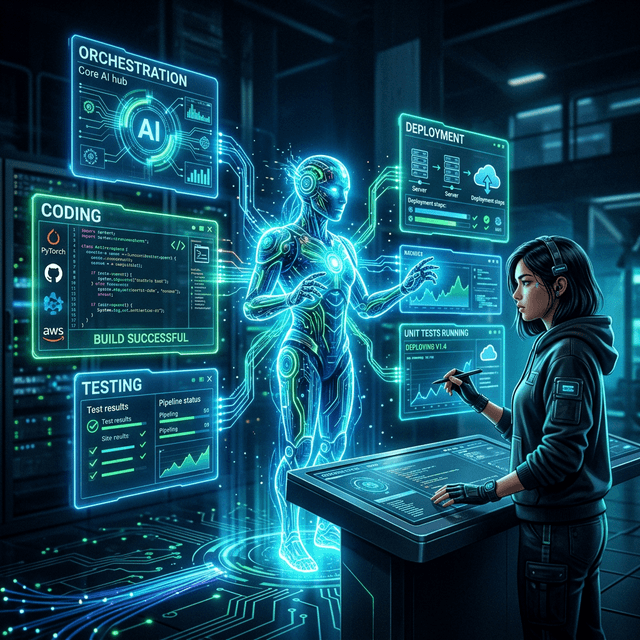
From Chat to Agent: Understanding the Paradigm Shift
The transition from AI chatbots to AI agents represents the most significant productivity leap in software engineering since the introduction of modern IDEs. A chatbot responds to individual queries—you ask a question, it provides an answer. An AI agent, by contrast, accepts a high-level goal and autonomously plans, executes, and iterates until the goal is achieved. The difference is agency: the ability to break complex tasks into subtasks, use tools (terminal, file system, browser, APIs), observe results, and adapt its approach based on feedback.
Consider the difference in practice. With a chatbot, you might ask 'How do I fix this TypeScript error?' and receive an explanation. With an AI agent, you say 'Fix all TypeScript errors in this project' and the agent reads the error log, identifies each error, determines the root cause, edits the appropriate files, runs the compiler to verify the fix, and moves to the next error—all without human intervention. The chatbot requires you to be the execution layer. The agent executes autonomously while you oversee.
The technology enabling AI agents combines large language models with tool use capabilities—the ability to invoke external functions. An agent can run shell commands, read and write files, make HTTP requests, interact with databases, and use browsers. Each tool invocation returns results that the agent observes and incorporates into its next decision. This 'observe-think-act' loop, repeated potentially dozens of times per task, is what gives agents their power.
For software engineers, AI agents are not replacing human judgment—they are eliminating the tedious execution work that consumes the majority of engineering time. Studies show that professional developers spend only 30-40% of their time actually writing code. The rest goes to reading code, debugging, writing tests, configuring environments, searching documentation, and managing deployments. AI agents excel at exactly these supplementary tasks, freeing engineers to focus on the creative, strategic work that defines their unique value.
Practical Agent Workflows: Coding, Testing, and Debugging
Code generation agents have evolved far beyond simple autocomplete. Modern coding agents can implement entire features from natural language descriptions. You describe the desired behavior—'Add a user authentication system using JWT tokens with refresh rotation, including login, registration, password reset, and email verification endpoints'—and the agent generates the route handlers, middleware, database schemas, validation logic, error handling, and test files. The key to getting good results is providing sufficient context: your tech stack, existing code patterns, and specific requirements.
Test generation is one of the highest-value applications of AI agents in software engineering. Writing comprehensive tests is essential but tedious—exactly the kind of work agents excel at. A testing agent can analyze your codebase, identify untested paths, generate unit tests, integration tests, and edge case tests, run the test suite to verify everything passes, and iterate on any failing tests until the suite is green. Teams using testing agents report doubling or tripling their test coverage within weeks.
Debugging agents combine diagnostic reasoning with the ability to actually modify and test code. Given a bug report or failing test, a debugging agent can reproduce the issue, add diagnostic logging, trace the execution path, identify the root cause, implement a fix, verify the fix resolves the issue without introducing regressions, and clean up the diagnostic code. Complex bugs that might take a human engineer hours of printf-debugging can often be resolved by an agent in minutes.
Refactoring agents are particularly powerful because refactoring typically involves many small, mechanical changes across multiple files—exactly the kind of tedious work where humans make mistakes and lose focus, but agents excel. A refactoring agent can rename a function across an entire codebase, extract common patterns into shared utilities, update import paths, modernize syntax, and ensure all tests still pass. The agent handles the mechanical execution while the engineer defines the desired outcome and validates the results.
- Feature implementation: describe the behavior in natural language, agent generates full implementation
- Test generation: agent analyzes code, generates comprehensive tests, runs and iterates until passing
- Debugging: agent reproduces issues, traces execution, implements and verifies fixes autonomously
- Refactoring: mechanical changes across multiple files with automatic test verification
- Key success factor: provide complete context—stack, patterns, requirements, and constraints
Building Effective Agent Workflows: Architecture and Patterns
The most effective engineering teams do not use agents for isolated tasks—they build agent workflows that automate entire development processes. A CI/CD-integrated agent workflow might look like this: when a new feature request is created, a planning agent breaks it into implementation tasks. A coding agent implements each task. A review agent analyzes the code for quality, security, and adherence to team standards. A testing agent generates and runs tests. A documentation agent updates relevant docs. A deployment agent creates the pull request with a comprehensive description. The human engineer reviews the complete output, provides feedback, and approves.
Effective agent architecture follows the 'human-in-the-loop' pattern—agents execute autonomously but humans retain approval at critical decision points. This pattern captures most of the productivity benefit of full automation while maintaining the quality control that fully autonomous systems currently lack. The art is in defining which decision points require human review: architectural choices, security-sensitive changes, and customer-facing modifications typically require human approval, while mechanical code changes, test generation, and documentation updates can proceed with minimal oversight.
Error recovery is a crucial aspect of agent architecture that many teams overlook. Agents will encounter failures—compilation errors, test failures, API timeouts, ambiguous requirements. Well-designed agent workflows include retry mechanisms with different approaches, escalation paths to human engineers when automated resolution fails, and comprehensive logging that enables post-mortem analysis. The worst outcome is an agent that fails silently, leaving the engineer to discover later that work was not completed as expected.
Context management is another architectural challenge. Agents need access to relevant context—project documentation, coding standards, API schemas, deployment configurations—but overwhelming them with too much context degrades performance. Effective architectures use dynamic context loading: the agent starts with a minimal context (project overview and current task) and retrieves additional context on demand as needed. This mirrors how human engineers work—you do not memorize the entire codebase, but you know where to look when you need specific information.
The Future: Where AI Agents Are Heading for Engineers
The current generation of AI agents is impressive but limited. They excel at well-defined tasks with clear success criteria but struggle with ambiguous requirements, novel architectures, and tasks that require deep domain understanding. The next generation—expected within 12-18 months—will address many of these limitations through improved reasoning capabilities, better tool use, and the ability to learn from project-specific context more effectively.
Multi-agent systems are an emerging paradigm where multiple specialized agents collaborate on complex tasks. Instead of one general-purpose agent, a planning agent coordinates with a frontend agent, a backend agent, a testing agent, and a DevOps agent—each optimized for its specific domain. These agents communicate through structured interfaces, sharing context and coordinating work much like a human engineering team. Early implementations show promising results, with multi-agent systems outperforming single agents on complex, multi-faceted tasks.
The integration of agents into existing development tools is accelerating. IDE plugins that provide agent capabilities directly in the editor, CI/CD tools that use agents for automated code review and issue resolution, and project management tools that use agents for task decomposition and estimation are all in active development or early deployment. Within two years, AI agent integration will likely be as standard as version control or automated testing—a fundamental part of every professional engineering workflow.
For software engineers, the strategic imperative is clear: invest now in learning to work with AI agents. Engineers who develop expertise in defining tasks for agents, reviewing agent outputs, building agent workflows, and understanding agent limitations will be dramatically more productive than those who do not. The engineers who thrive will be those who think of themselves not as individual coders but as engineering leaders who orchestrate a team of AI agents to execute at a pace and scale that was previously impossible.
- Current agents excel at well-defined tasks; next-gen will handle ambiguity and novel architectures
- Multi-agent systems: specialized agents collaborate like a human team for complex projects
- IDE, CI/CD, and project management tool integration is accelerating rapidly
- Agent orchestration will be as standard as version control within 2 years
- Strategic imperative: learn to define, review, and orchestrate agent workflows now
- Engineers evolve from individual coders to leaders orchestrating AI agent teams
Related reading
Mar 12, 2026
The Advantages of OpenClaw: Why This Open-Source AI Agent Is Changing How We Work
Privacy-first, open-source, and integrated into every chat app you use — OpenClaw offers unique advantages over cloud-based AI assistants. Here is why developers and professionals are making the switch.

Mar 11, 2026
How to Use Claude AI Effectively: A Practical Guide for Developers and Professionals
Claude by Anthropic is one of the most capable AI assistants available. This hands-on guide shows you exactly how to leverage Claude for coding, analysis, writing, and complex problem-solving.
Mar 8, 2026
The Advantages of Claude AI: Why More Teams Are Switching to Anthropic's AI Assistant
From its industry-leading context window to its safety-first design philosophy, Claude offers unique advantages that are making it the AI assistant of choice for developers, researchers, and businesses.