RAG vs Fine-Tuning: Which One Do You Need?
RAG vs fine-tuning, explained for builders: what each one does, the cost, latency and freshness trade-offs, and a simple checklist to pick the right one.
RAG vs Fine-Tuning: Which One Do You Need?
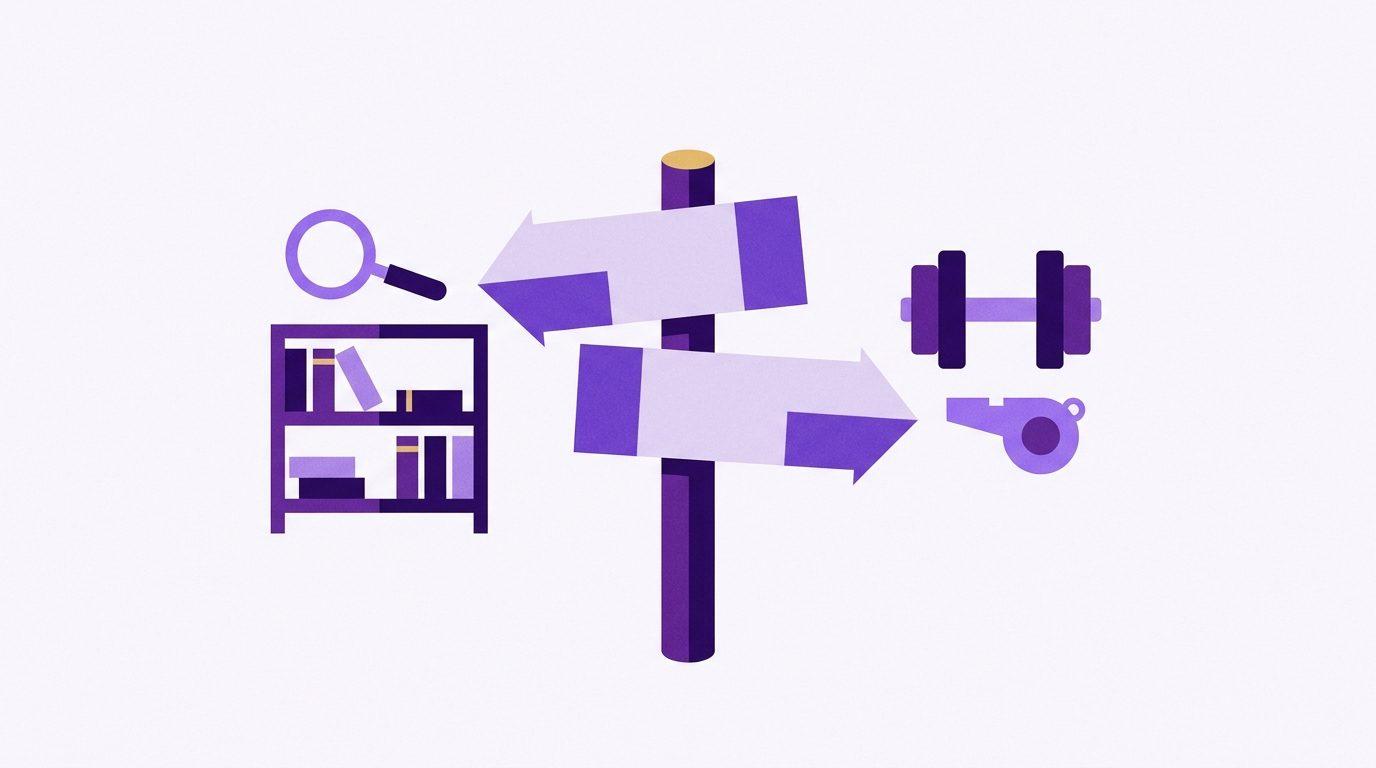
Use RAG when the model needs to know things: your docs, your product data, anything that changes. Use fine-tuning when the model needs to behave differently: a fixed tone, a strict output format, a narrow task done the same way every time. Most teams should start with a good prompt, add RAG next, and fine-tune only when both fall short.
The short version: RAG changes what the model sees. Fine-tuning changes how the model responds. They solve different problems, so the real question is which problem you have.
What Is RAG and What Does It Do?
RAG stands for retrieval-augmented generation. You keep your knowledge outside the model, in a search index. On every request you find the passages that match the question, paste them into the prompt, and ask the model to answer from them.
The model itself never changes. You can swap it for a newer one tomorrow and keep the same index. Updating knowledge means re-indexing a document, not retraining anything.
RAG also gives you citations. Because you know which passages went into the prompt, you can show the user where the answer came from. Our step-by-step RAG guide covers the full pipeline: loading, chunking, embeddings, a vector store, retrieval, reranking and evaluation.
What Is Fine-Tuning and What Does It Do?
Fine-tuning continues training a model on your own examples. You collect pairs of input and ideal output, run a training job, and get a new version of the model that leans toward those outputs.
It is good at teaching patterns. Think of a house writing style, a JSON shape the model must always follow, a classification task with your own labels, or domain phrasing a general model keeps getting wrong. A tuned model does these without long instructions in every prompt.
It is bad at teaching facts. A tuned model does not look anything up. It cannot tell you which document an answer came from, and it knows nothing that happened after its training data was collected. When a fact changes, you train again.
RAG vs Fine-Tuning: Cost, Latency, Freshness and Citations
These four trade-offs decide most projects. None of them has a universal winner, so weigh them against your own workload.
Cost works differently for each. RAG costs you on every request: an embedding call, a vector search, and a longer prompt full of retrieved text. Fine-tuning costs you up front: preparing clean training data, running the job, and evaluating the result. Some platforms also charge more to serve a tuned model. Check the pricing page of your provider before you assume either one is cheaper.
Latency favors fine-tuning on paper. A tuned model answers from a short prompt with no retrieval step. RAG adds a search hop, often a rerank, and more input tokens. In practice you can hide much of this by streaming the answer and caching common questions.
Freshness and citations favor RAG clearly. Re-index a page and the next answer uses it. Every answer can point back to its sources. Fine-tuning gives you neither.
- Cost: RAG pays per request, fine-tuning pays per training run plus the data work
- Latency: fine-tuning has fewer steps and shorter prompts, RAG adds retrieval time
- Freshness: RAG updates when you re-index, fine-tuning updates when you retrain
- Citations: RAG can show sources, a fine-tuned model cannot
- Model upgrades: a RAG index works with any new model, a fine-tune is tied to its base model
- Data needed: RAG needs documents, fine-tuning needs many high-quality examples
When Should You Use RAG vs Fine-Tuning? A Simple Checklist
Run through these questions in order. Stop at the first one that fits.
One rule of thumb covers most cases. If a new employee could do the task with the right documents open, you need RAG. If they would need weeks of practice and feedback to get the style right, you need fine-tuning.
- Can a clearer prompt with a few examples fix it? Do that first. It costs almost nothing
- Does all the knowledge fit in the context window and rarely change? Put it in the prompt and skip retrieval
- Does the answer live in documents you control? Use RAG
- Does the data change weekly, daily or per user? Use RAG
- Do users or auditors need to see sources? Use RAG
- Is the problem tone, format or a narrow repeated task, and prompting did not fix it? Consider fine-tuning
- Do you need a smaller, cheaper model to match a bigger one on one task? Consider fine-tuning
- Do you lack a solid set of clean input and output examples? You are not ready to fine-tune yet
Can You Use RAG and Fine-Tuning Together?
Yes, and mature systems often do. The two fix different halves of the problem, so they stack well.
The common setup is a fine-tuned model for behaviour and RAG for knowledge. The tuned model has learned your format and tone. Retrieval hands it current facts on each request. You get consistent output that still cites live sources.
You can also fine-tune the pieces around the LLM. Teams tune an embedding model or a reranker on their own domain so retrieval finds better passages. That is often a cheaper win than tuning the generator.
Build in order. Get RAG working with a stock model and measure it. Add fine-tuning only when you can name the specific failure it will fix.
Can You Still Fine-Tune Models From the Big Providers?
Sometimes, and it keeps changing. Hosted fine-tuning has always covered only some models from each provider, usually not the newest ones. At the time of writing, OpenAI has announced it is winding down its self-serve fine-tuning platform, Google offers tuning for selected Gemini models through its cloud platform, and Amazon Bedrock offers customization for a limited set of models. Read the current docs before you plan around any of them.
Open-weight models are the stable option. You can fine-tune Llama, Mistral and similar models yourself with adapter methods such as LoRA, and you own the result. The price is that you now run training and serving infrastructure.
This is one more reason to start with RAG. A retrieval pipeline does not depend on any provider's tuning programme. If a model is retired, you point the pipeline at a different one.
Common Mistakes When Choosing Between RAG and Fine-Tuning
Most wasted effort comes from picking the tool before naming the problem. These are the common ones.
- Fine-tuning to add facts. The model still makes things up, and now the facts are frozen in time
- Skipping prompt work. Many tone and format problems disappear with clear instructions and a few examples
- Blaming the model for bad retrieval. If the right passage never reaches the prompt, no fine-tune will save the answer
- Fine-tuning on a handful of messy examples. Bad training data teaches bad habits
- Building RAG without a test set. You cannot tell whether a change helped
- Forgetting upkeep. RAG needs re-indexing, and a fine-tune needs retraining when the base model is retired
Frequently Asked Questions
Is RAG better than fine-tuning?
Neither is better in general. RAG is better for knowledge that changes and for answers that need sources. Fine-tuning is better for consistent style, strict formats and narrow tasks. Pick based on whether your problem is knowledge or behaviour.
Is RAG cheaper than fine-tuning?
RAG is usually cheaper to start because you need no training data and no training job. Its cost grows with traffic, since every request pays for retrieval and a longer prompt. Fine-tuning costs more up front and can cost less per request at high volume, so compare both against your provider's current pricing.
Does fine-tuning stop hallucinations?
No. A fine-tuned model still generates text from patterns, and it will state wrong facts with confidence. Grounding answers in retrieved passages and telling the model to say it does not know is the more reliable fix.
How much data do you need to fine-tune a model?
It depends on the task and the model, so there is no single number. Simple format or classification tasks need fewer examples than subtle style changes. Start small, evaluate, and add data where the model still fails. Quality matters more than volume, and you need a held-out set to check the result.
Can I use RAG with a fine-tuned model?
Yes. Retrieval works with any model that accepts a prompt, tuned or not. A common setup uses a fine-tuned model for tone and format while RAG supplies current facts and citations.
Keep reading
All guides →
Vector Databases for RAG: Pinecone vs pgvector vs Chroma
Pinecone vs pgvector vs Chroma for RAG: hosting, scaling, filtering, hybrid search and ops burden compared, with notes on FAISS, Qdrant and Weaviate.
15 n8n Workflow Examples You Can Build Today
15 practical n8n workflows for alerts, data sync, AI, DevOps and content. Each one lists the trigger, the main nodes and the gotcha that bites first.
n8n AI Agent Tutorial: Build Your First Agent
Build your first n8n AI agent step by step: Chat Trigger, AI Agent node, chat model, memory and tools. Plus the limits and mistakes to know before you ship.